

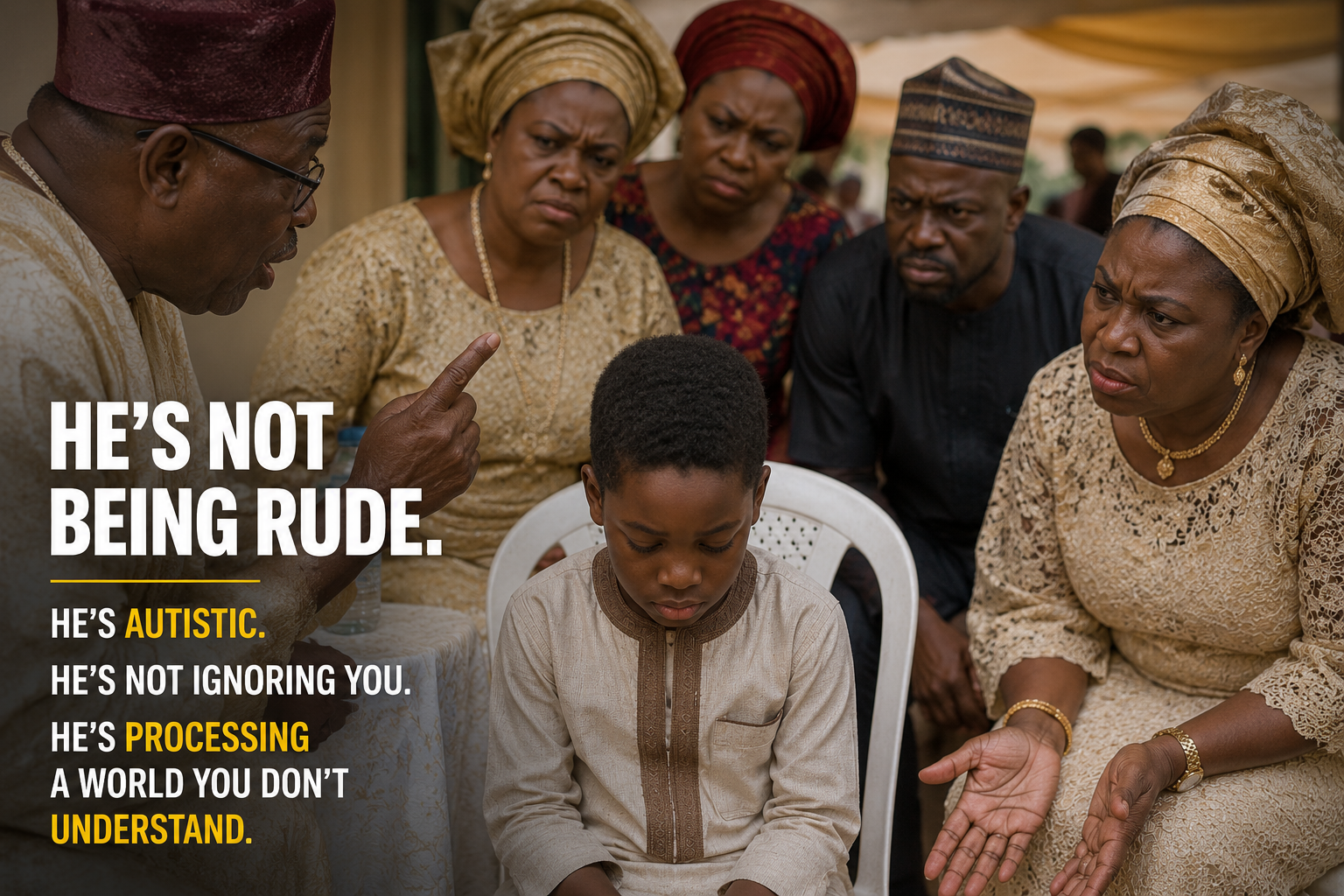
How to explain autism to African families who think it’s bad behaviour
In many African families, autism spectrum disorder is often mistaken for a behavioural issue, poor discipline, or “bad manners dressed up differently.” In reality, autism is none of these. It is a neurodevelopmental difference that affects how the brain processes and responds to the world.
It shows up in how a person communicates, reacts to social expectations, manages sensory input, and interprets other people’s intentions. And because those differences are often invisible, they are frequently misunderstood, especially in environments where behaviour is judged more than context is understood.
On May 18, at the gym, one of my acquaintances confronted me. He was convinced I had been deliberately ignoring his calls and texts for a few weeks. He was genuinely hurt, and I was genuinely confused. Because I could recall, clearly, the specific day — in March 2026 — he was referring to. I had been on a phone call when his call came in, and he had walked up to me mid-conversation and seen it himself. Yet somehow, months later, the story had become, “she ignored me.”
That conversation frustrated me more than I expected. Not because he was upset; I understood that. But because it reminded me how quickly people write a narrative in their heads and lock it there rather than ask a simple question. A two-minute conversation could have cleared everything up, if there had been room for it.
What he had decided was disrespect was actually just me — not a bad character problem. Being autistic. Processing at my own pace. Not always responding the way the social script expects.
And that is exactly where the challenge begins in many African families: autism often gets interpreted through the lens of obedience, respect, and “normal behaviour,” rather than neurodevelopment. So instead of asking, “What does this child need to function better?”The question becomes, “Why is this child not behaving properly?”
To explain autism to an African family that doesn’t understand, it helps to start with what it is not. It is not stubbornness. It is not a lack of home training. It is not spiritual punishment or bad upbringing. It is a different wiring of the brain that affects communication, sensory experience, and flexibility in routine or expectations.
The weight of “proper behaviour” in autism
If you grew up in an African household, you already know the rules. Greet every elder properly. Make eye contact when someone speaks to you. Respond quickly. Sit still in public. Don’t embarrass the family.
These are not small expectations. In many African communities, a child’s behaviour is treated as a direct reflection of their home, their parents, and their upbringing. Which means that when an autistic child struggles to meet those expectations — not out of defiance, but out of genuine neurological difference — the conclusions drawn can be painful.
“This child is stubborn.” “Someone needs to discipline him.” “She’s becoming disrespectful.” “Take the child for deliverance.”
These comments are not always rooted in cruelty. In many cases, they come from people who genuinely believe they are helping. Cultural factors significantly influence how autism is perceived in African communities, and much of the available knowledge about autism in Africa remains limited. For generations, anything outside what was considered “normal” behaviour was explained through the lens of discipline, spirituality, or parenting failure, because those were the frameworks available.
The problem is that those frameworks don’t fit autism. And when they are applied anyway, the consequences fall hardest on the children and the parents left to defend them.
What autism actually is without the medical jargon
Autism is a neurodevelopmental condition. In plain terms, it affects how a person’s brain processes communication, sensation, emotion, and social interaction. It is not a disease. It is not the result of bad parenting. It is not a spiritual problem.
Emerging research now recognises autism as a difference rather than a deficit. Autistic people have their own distinct communication styles, often more direct and literal, which are frequently misunderstood by non-autistic individuals. Importantly, a 2025 study found that autistic people communicate equally well when paired with others who share their communication style, suggesting that so-called social difficulties are not a sign of inability, but of a mismatch in styles.
That reframe matters enormously. Because what gets labelled “rude” or “difficult” in an autistic child is often not attitude; it is different wiring.
An autistic child who doesn’t greet the way you expect may not be disrespecting you. Greeting rituals involve eye contact, timing, social cues, and appropriate vocal tone, and for many autistic people, all of those things happening simultaneously is genuinely overwhelming. Research on autistic adults found that navigating nonverbal communication — eye contact, facial expressions, tone — requires intense mental effort and frequently leads to being misread and unfairly judged.
That child who goes quiet at a family gathering? They are not being antisocial. They are likely managing sensory overload in the only way they know how.
Why the African cultural context makes this harder
Autism remains understudied across Africa, and many communities face significant challenges in understanding and recognising it, not just among families but among healthcare providers as well. This isn’t a failure of intelligence. It’s a gap in exposure.
When autism has never been part of the conversation, behaviour gets explained through whatever vocabulary is available. And in many African households, that vocabulary is moral, spiritual, and cultural, not neurological.
There is also the communal dimension of African parenting. In many communities, raising children is not considered a private matter. Extended family members, neighbours, church leaders — everyone has an opinion. And when a child behaves “differently,” the judgement doesn’t only land on the child. It lands on the mother, the father, and the household. Research on Black caregivers of autistic children found that family messaging often fell into two extremes — either a lack of understanding and outright denial or supportive acceptance — with very little in between.
For parents already navigating diagnosis, therapy, sensory management, and the daily emotional weight of caregiving, having to also manage extended family perceptions can be the thing that tips them over the edge. Many stop attending family gatherings altogether, not because they don’t want connection, but because the cost of explaining, defending, and absorbing commentary becomes too high.
Faith also plays a significant role. In families where spiritual explanations are the first response to anything misunderstood, an autistic child’s behaviour can be labelled as a spiritual attack, a curse, or a sign of something that needs deliverance rather than support. Prevalent misconceptions about autism often lead to social isolation and discrimination against individuals with autism and their families across African communities. Per studies, faith can absolutely be a source of comfort and resilience for families, but when it replaces understanding entirely, the child is the one who pays the price.
What it feels like from the inside, a perspective you don’t hear enough
Imagine knowing that every time you walk into a room, you are about to be assessed. Not for who you are, but for whether you perform the correct social choreography in the correct order at the correct speed. Greet this person, make eye contact, respond quickly, smile appropriately, don’t fidget, and don’t go quiet.
Now imagine that most of those things require active, effortful processing for you — the way mental arithmetic requires effort for someone who struggles with numbers. You’re not being lazy. You’re not being rude. You are working extraordinarily hard to do something that other people do automatically. And yet the room sees the slight delay, the averted gaze, the quietness, and decides you have an attitude.
Autistic adults in research studies consistently describe being marginalised as a direct result of their communication differences, experiencing disrespect that ranged from being overlooked or rejected to far more serious forms of social harm.
That marginalisation doesn’t only happen in Western contexts. It happens at African family dinners, at church gatherings, at community events, at school, wherever the expectation of “proper behaviour” is enforced without curiosity about what is actually happening underneath.
The frustration is not that people notice the difference. It is that they almost never ask.
Addressing the autism myths directly
Before we talk about how to have these conversations, let’s name the most common assumptions and why they don’t hold up.
“It’s bad parenting.” Autism is not caused by how a child is raised. It is a neurodevelopmental condition, a difference in how the brain develops and processes information that is present regardless of home environment. The most loving, structured, consistent household can raise an autistic child. The two are not connected.
“Autistic children can’t learn or improve.” This one is not only wrong but harmful. Autistic individuals learn, grow, build relationships, and achieve significantly when they are supported in ways that match how they actually learn. The problem is not the child. It is when the system forces them into one single mould.
“But he looks normal.” Autism does not show up on the face. It affects how the brain processes the world, not physical appearance. Many autistic people look entirely “typical” and still experience profound challenges with communication, sensory input, and social interaction. Appearance is not a diagnostic tool.
“Autism isn’t real; in our time, children didn’t behave like this.” Children have always been neurologically diverse. What has changed is our ability to recognise and name it. Many children from earlier generations were simply misunderstood, labelled, punished, or quietly sidelined, without ever being properly seen.
“It must be spiritual.” Autism is a developmental condition documented across every country, culture, and religion in the world. In many African communities, cultural beliefs can overshadow scientific understanding of autism, but faith and understanding are not mutually exclusive. You can hold both. What families cannot afford to do is let one fully replace the other.
How to have the autism conversation practically
This is usually the hardest part. Not understanding autism yourself, but finding the words to explain it to someone who has never considered it, and may actively resist the idea.
A few things that actually help:
Start with one person, not the whole family. Trying to educate an entire extended family at once usually results in defensiveness and noise. Find the one person who is most likely to listen without immediately shutting things down. It could be a sibling, a cousin, a parent who can hold complexity. When one person genuinely understands, they often become an internal advocate. In African family systems, change spreads through relationships, not announcements.
Use feelings, not textbooks. Most people do not connect with diagnostic language. They connect with experience. Instead of “autism affects social communication,” try: “Loud environments cause him real pain, the same way a bright light causes pain to someone with sensitive eyes.”
Or: “She’s not ignoring you. It takes her longer to respond in social situations, the way it takes some people longer to find the right word in a second language.”
When people can feel their way into understanding, something shifts.
Focus on what helps, not on who’s wrong. It is tempting, and entirely understandable, to want to correct every misguided comment. But in practice, explaining what the child needs tends to land better than arguing about what relatives got wrong. “What helps him most is patience when he doesn’t respond immediately” invites someone into action. “You’re wrong about him” mostly invites defensiveness.
Let other voices do some of the work. Sometimes your own voice, especially when you are emotionally close to the situation, carries less weight than an outside one. Short videos, real-life stories, or information from credible sources can reach people in ways that a direct conversation doesn’t. If possible, choose examples that feel culturally familiar, not just Western children in clinical settings, but stories that look and sound like your family’s world.
Ready-to-use responses for common comments
These are not scripts to win arguments. They are gentle redirects, ways to plant understanding without starting a war.
| What they say | What you can say |
| “He just needs discipline.” | “Discipline is still important, but autism affects how his brain processes information. What looks like defiance is often overwhelm.” |
| “She doesn’t greet properly; she’s rude.” | “She’s not being rude. Social greetings are genuinely difficult for her. She’s still learning to express herself in her own way.” |
| “But he looks fine.” | “Autism isn’t visible from appearance. It affects communication and how the brain processes the world, not how someone looks.” |
| “In our time, children didn’t behave like this.” | “Children have always been different. We just understand more now than we used to.” |
| “Maybe it’s spiritual.” | “I understand why you’d think that. Prayer brings comfort, and I welcome that. But autism is also a neurological difference that needs practical support alongside spiritual care.” |
| “He ignores people on purpose.” | “It may look that way, but he often needs more time to process and respond. It’s not intentional.” |
You don’t need to convince everyone in one conversation. You just need to plant something clearer than what was there before. Repetition — calm, consistent, patient — does more work over time than a single perfectly argued point.
A word to the parents and carers
If you are a parent navigating this — the daily care, the explanations, the family gatherings where you brace yourself before you even walk in — this part is for you.
You are not failing your child because others don’t understand them yet.
The fact that awareness is still growing in your community does not diminish your effort or your love. It means you are doing this in harder conditions than you should have to. And that is worth naming.
It is also entirely reasonable to protect your energy. You do not have to defend your child in every conversation, with every person, every time. Some people will take longer. Some may never fully get there. Deciding which conversations are worth having, and which ones are not, is not giving up. It is survival.
Find the one person who gets it. Build from there. And where possible, find a community, whether in person or online, where you are not the only one explaining.
You should not have to carry this alone.
Where things are heading
Understanding is growing. Slowly, genuinely, and not always in a straight line; but it is growing.
Grassroots initiatives and advocacy efforts are emerging across African communities, aiming to enhance understanding, provide support networks, and promote inclusivity for individuals with autism. Younger generations are more open to new language and frameworks. Conversations that felt impossible in some families five years ago are now, at least, beginning.
Every patient explanation contributes to that shift. Every moment where someone pauses, reconsiders, and sees a child differently than they did before. That is the work. It does not always feel significant in the moment. It adds up.
Understanding autism in African families does not begin with everyone agreeing at once. It begins with one conversation that makes someone ask a question instead of issuing a verdict.
That conversation is worth having. Even when it’s hard. Even when it’s the hundredth time.
Because on the other side of it is a child who gets to exist, not as a problem to be corrected, but as a person to be understood.




Parents can actually do better
I grew up totally lost socially both in my family and outsiders….. Everyone drifted from me and kept saying “you can’t make friends”
But growing up, I was able to learn many tht
Thanks for the piece
Hello, Daxon. Thank you for your kind words.