

Every brain learns differently: The truth about neurodiversity
The first time I heard the word ‘neurodiversity’, or even became aware that there might be a name for what I was experiencing, was probably around 2019. At that time, I was trying to find answers for something I couldn’t quite explain: why I didn’t seem to learn the same way as some of my peers.
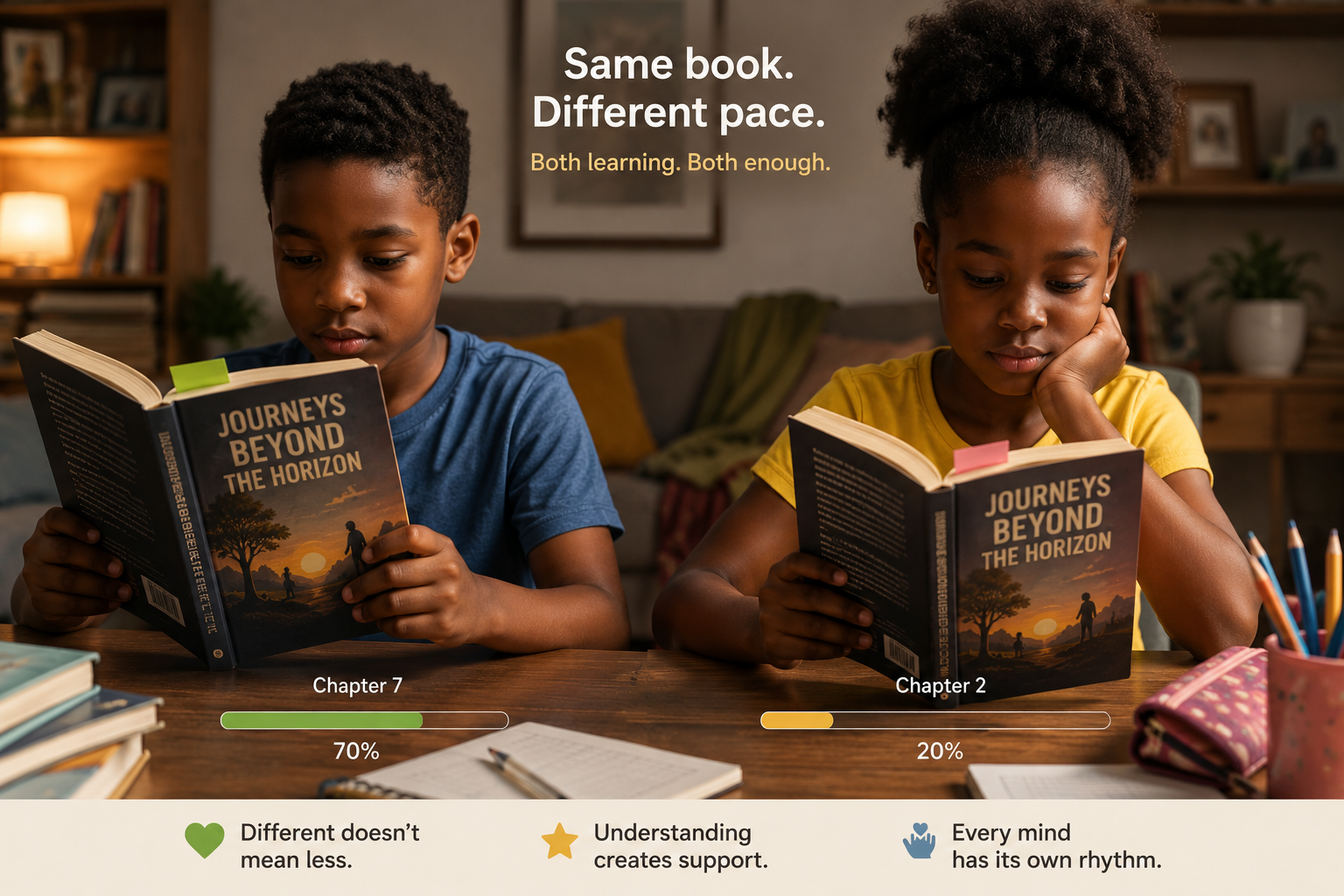
I was in secondary school, around year 7 or 8. One of the brightest students in class was sitting next to me, and we ended up reading the same passage together. It wasn’t a competition exactly; more an unspoken, spontaneous challenge. She moved through pages quickly, flipping forward with what seemed like complete ease. I remember watching her and feeling genuinely baffled. How could she read that fast and still know what she’d read?
I stopped her and asked her to summarise what she had read. Interestingly, she did so clearly and confidently, without missing a beat. That was the moment it clicked for me that my way of learning was probably just one of many ways.
I was still going through the same pages slowly, and even then, I wasn’t retaining much. I was trying just as hard, perhaps even harder, but something about the way my brain processed what I was reading was simply different from hers.
I didn’t have a word for it then. I didn’t think there was one. I just quietly filed it under “that’s how things are for me” and kept going.
It wasn’t until university that I encountered the word neurodiversity, and something quietly clicked into place. Not a diagnosis, not a category, just a frame: the understanding that brains don’t all work the same way, that learning doesn’t have to look identical to be valid, and that the version of me sitting in that classroom wasn’t falling behind; she was processing differently.
I want to give that frame to every parent, teacher, and child who hasn’t found it yet.
What neurodiversity actually means
Neurodiversity is a straightforward idea dressed up in unfamiliar language. It simply means that human brains vary naturally, normally, and meaningfully in the way they process information, learn, communicate, and experience the world.
There is no single correct way for a brain to work. There are many versions of neurological differences, including autism, Attention Deficit Hyperactivity Disorder (ADHD), dyslexia, dyspraxia, dyscalculia, and others, each shaping how a person thinks and learns in distinct ways.
There isn’t a single reliable, official figure for neurodivergent populations in Africa because most African countries do not yet have comprehensive screening systems or consistent national reporting on neurodevelopmental conditions. However, research on specific conditions gives useful estimates that can be used in context.
For example, a systematic review and meta-analysis found that ADHD affects about 7.47% of school-aged children and adolescents in Africa. Autism research in African countries is more limited, but available studies suggest a global prevalence of around 1%–2%, with African data still likely underreported due to gaps in diagnosis, awareness, and access to assessment services.
That is not a small number. It represents millions of children across the continent, including a significant proportion of those sitting in classrooms today.
However, many neurodivergent children in Africa are still in mainstream schools without formal identification or support. Consequently, their learning differences are often misunderstood, and they may be wrongly labelled as “lazy”, “difficult”, or “not intelligent”, rather than being recognised as children who simply learn in different ways and may need different kinds of support to thrive.
And yet the way most classrooms are structured — how lessons are delivered, how attention is assessed, how understanding is measured — tends to be designed around one particular way of learning. When a child doesn’t fit that design, the problem is almost always attributed to the child rather than to the fit.
What neurodiversity looks like in real life, including mine
Let me be concrete, because theory without grounding is easy to dismiss.
The child who gets up repeatedly during homework, moves around the room, and finds it impossible to stay sitting for long stretches? This is frequently read as not paying attention. But for many children with ADHD or sensory processing differences, movement is not a distraction from thinking. It’s part of how thinking happens. Stillness can actively impair their ability to concentrate, not support it.
The child who knows an extraordinary amount about a narrow subject — who can recite every detail of a topic they care about but seems lost in general class discussion — is often seen as uneven, inconsistent, or difficult to engage. For many autistic children, depth of interest is not a quirk to be managed. It is how learning works for them. The interest is the entry point.
The child who takes a long time to answer a question, who pauses before responding, and who seems uncertain even when they clearly know the material? This child is frequently mistaken for disengaged or unprepared. But processing speed varies enormously. The pause is often thinking, not blankness.
And the child who struggles in a noisy classroom — who shuts down, becomes restless, or seems to retreat when the noise level rises — is often told to concentrate harder. But for children with sensory sensitivities or autism, the environment itself is the barrier. Asking them to learn through it is a bit like asking someone to read clearly through frosted glass and attributing the difficulty to poor eyesight.
None of these is a sign that something is wrong with these children. They are signs that the environment, the expectation, or the approach isn’t matching how the child’s brain actually works.
The strengths that get missed when we only measure one thing
Here is the thing about neurodivergent children that gets consistently underemphasised: they are frequently very good at things that the standard academic frame doesn’t think to measure.
Pattern recognition. Deep, focused engagement with things they find genuinely interesting. Creative problem-solving that doesn’t follow expected routes. The ability to notice details others overlook. Honesty, directness, and a strong internal sense of fairness. Memory that works with extraordinary precision in some domains, even when it struggles in others.
Research from the University of Birmingham found that neurodivergent traits don’t exist in neat, separate boxes; there are significant overlaps, and unique strengths exist alongside the challenges within each condition. The picture is far more complex and more interesting than a deficit model would suggest.
A child who struggles to sit still and complete a worksheet may be the same child who can hold an entire game system in their head, manage competing variables simultaneously, and problem-solve in real time in ways their peers can’t. A child who finds reading comprehension slow and laborious may be producing the most imaginative, creative writing in the class.
Measuring only one kind of ability doesn’t tell us what a child can do. It tells us what a child can do in that particular format, under those particular conditions. That’s a much narrower thing.
What the research says about what helps, and what doesn’t
Research consistently shows that neurodivergent children educated in mainstream classrooms face poor outcomes compared to neurotypical peers and that these outcomes can be caused or made worse by the negative attitudes and actions of classmates, not just by the conditions themselves. This matters because it tells us something important: a significant part of the difficulty neurodivergent children experience is not internal. It is environmental and social. It can be changed.
A 2024 UK Parliamentary briefing confirmed that neurodivergent children and young people face substantial barriers to support in both healthcare and education, and that the gap between need and provision remains significant.
What helps is not complicated, even though it is often under-resourced. Processing time — pausing after a question, not filling silence, allowing a child to formulate a response without pressure — costs nothing and changes a great deal. Visual supports, consistent routines, clear and specific instructions rather than vague ones, and reducing unnecessary sensory load in learning environments all make meaningful differences for neurodivergent children without detracting from anything for anyone else.
Avoiding comparison is one of the quieter but more important things adults can do. Every time a child is held up against another child’s pace, style, or output, the implicit message is that one way of learning is correct and theirs isn’t. That message accumulates. It shapes how children understand their own capability, often in ways that take years to undo.
A note to parents specifically
If your child learns differently, I want to say this directly: the question is not what’s wrong with them. The question is what kind of support would let them show you what they’re actually capable of.
That reframe matters. Because a child who believes they’re the problem learns to navigate the world with a particular kind of exhaustion — the kind that comes from constantly trying to fit something that was never made to fit them. I know that exhaustion from the inside. It’s not what you want for your child.
What you want is a child who understands that their brain is wired differently, not wrongly. A child who has language for their experience, tools that match how they learn, and adults around them who are curious about how they think rather than simply concerned about how they perform.
That is what neurodiversity, understood well, makes possible.
Frequently Asked Questions (FAQs)
Is neurodiversity a disability?
Neurodiversity itself describes natural variation in how brains work. It is not a disability. However, some neurodivergent people do experience significant challenges in environments not designed with them in mind, and some have diagnoses that qualify as disabilities. The distinction matters because it affects what support and accommodations a child is entitled to.
Can neurodivergent children succeed in school?
Yes, and many do, particularly when given the right environment and support. What that looks like will differ between children. The goal is not for neurodivergent children to simply endure school. It is for schools to be structured in a way that actually allows them to learn.
How can parents support different learning styles at home?
Pay attention to when your child learns best, not just whether they’re learning. Use visual aids and consistent routines where possible. Give processing time, ask a question and wait, rather than repeating or rephrasing immediately. Celebrate things that aren’t grades: curiosity, persistence, creativity, kindness. And if your child is struggling, listen to how they describe it before deciding what it means.
What are examples of neurodivergent conditions?
Autism, ADHD, dyslexia, dyspraxia, dyscalculia, dysgraphia, and Tourette’s syndrome are among the most commonly recognised. Many people are neurodivergent in more than one way, and the conditions frequently overlap. Research confirms significant overlap between traits associated with different neurodivergent conditions; someone with high autistic traits, for instance, often also shows traits associated with ADHD or dyslexia.