

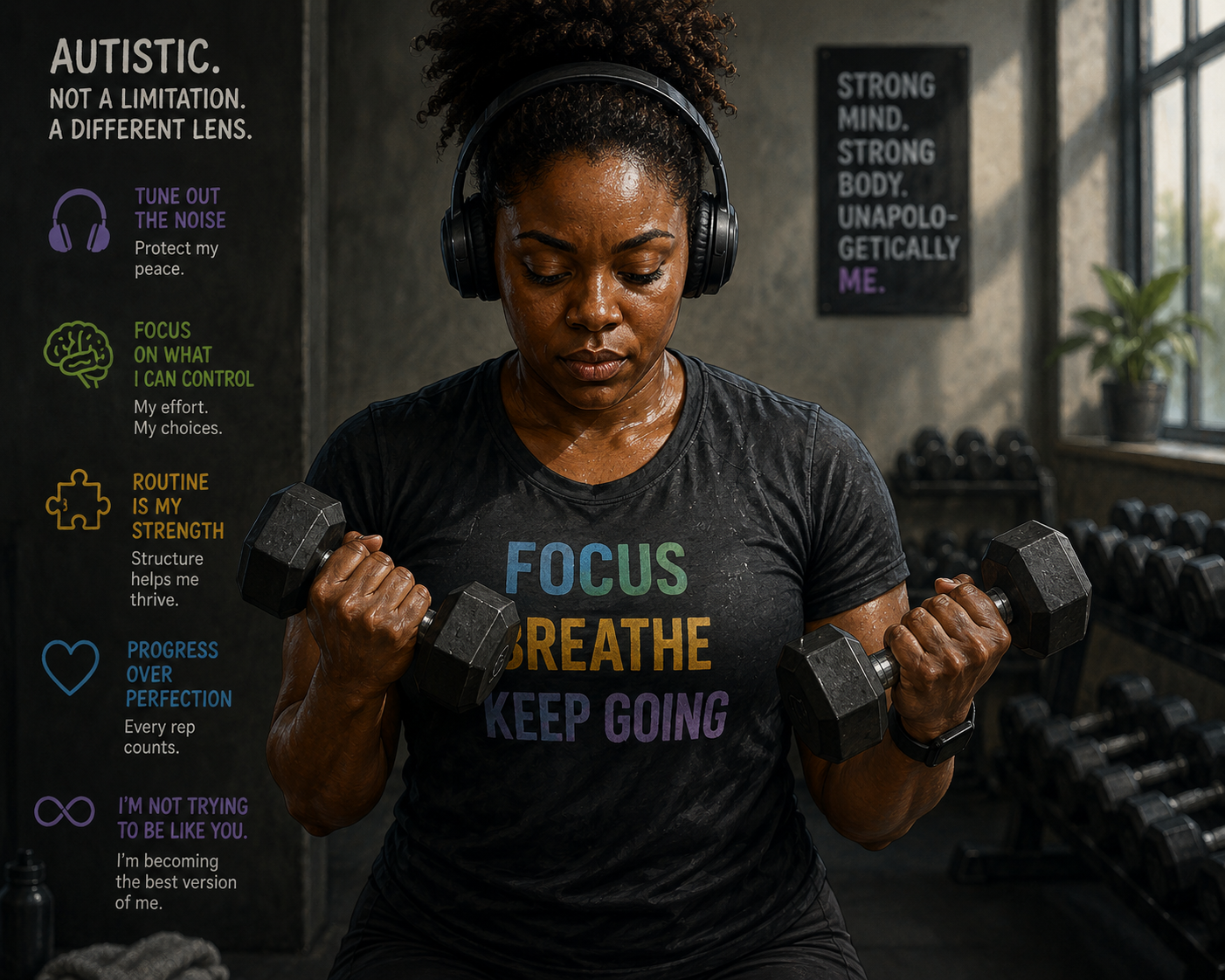
The sensory overload truth about exercise in autism
Not every tiredness is the same. There’s the tiredness of a good workout, and there’s the tiredness of simply surviving a room. I’ve had both in the same week, and they are not remotely the same feeling, which is exactly why I think this conversation needs more nuance than “just get moving” or “try to relax more.”
For some autistic children, the words “PE lesson” or “team sport” bring more dread than excitement. The noise of a sports hall, the pressure to follow fast-moving instructions, the unpredictability of a game in progress, and the feeling of being watched by other children can make something that’s supposed to be fun feel genuinely overwhelming.
But that doesn’t mean movement itself is the problem. A child who finds football too chaotic might happily swim lengths of a pool for half an hour. Another might avoid organised sport altogether but light up when riding a bike around the park. Someone else might love the steady, repetitive rhythm of bouncing on a trampoline, while another person’s favourite form of exercise is a quiet walk along a familiar route.
These don’t look much like conventional ideas of sport. But for the person doing them, they offer something far more important: a way to move that feels enjoyable, predictable, and genuinely their own.
Physical activity and autism
Before we go any further, let’s start with something that is part of everyday life for all of us: movement.
Physical activity is an important part of a healthy lifestyle. It refers to any movement of the body produced by the muscles that requires energy, and it includes much more than structured exercise or competitive sport. Physical activity can be as simple as walking to school or work, cycling, playing, dancing, spending time outdoors, doing household tasks, or taking part in a favourite sport or activity.
In other words, being physically active does not have to mean going to the gym, following an exercise programme, or being particularly sporty. Movement can look different for everyone. What matters is finding ways to move that fit into everyday life and that feel enjoyable, comfortable, and meaningful.
The World Health Organization (WHO) recommends that children and adolescents aged 5–17 years take part in an average of at least 60 minutes of moderate- to vigorous-intensity physical activity each day across the week. For adults, the recommendation is 150–300 minutes of moderate-intensity physical activity or 75–150 minutes of vigorous-intensity physical activity per week, together with muscle-strengthening activities on at least two days each week.
These recommendations give us a useful starting point, but they should not make physical activity feel like a tick-box exercise. People have different interests, abilities, routines, environments, and ways of experiencing movement. There is no single “right” way to be active.
This is especially important when we talk about autistic people. Autism is experienced differently by every person, and this includes how someone may experience and engage with physical activity. Some people may enjoy swimming, cycling, running, dancing, walking, or team sports, while others may prefer individual activities, movement at home, or simply being active in ways that fit naturally into their day.
For some autistic people, things such as sensory experiences, changes in routine, communication, or the environment itself may influence how comfortable or enjoyable an activity feels. For others, these things may not be significant at all. There is no one autistic experience of physical activity.
Recognising this is important because physical activity should not be about expecting autistic people to fit into a particular idea of what being active looks like. Instead, it is about creating opportunities for movement that recognise individual preferences, strengths, and experiences.
So, when we talk about physical activity and autism, the conversation is not simply about whether someone is meeting the WHO recommendations. It is also about what being active looks like for that person, what they enjoy, what works for them, and how we can make movement a positive and accessible part of everyday life.
The gym, the spa, and the paint night: three very different kinds of tired
I go to the gym often, and I’ll be honest, I’m usually wrecked by the time I leave. Not dramatically collapsed on the floor, just properly, thoroughly tired, the kind that sits on my shoulders for the rest of the day. And yet I keep going back.
Part of what keeps me returning is the structure. I use roughly the same machines in roughly the same order. I know what to expect. I can count my reps and focus on what my body is doing, and nobody expects me to make conversation mid-set. It’s one of the few physical spaces where I feel completely in control of my own body. I don’t leave energised; I leave tired and somehow steadier. That took me a long time to make peace with, because we’re constantly told exercise should leave us feeling amazing and refreshed. For me, it doesn’t. It doesn’t need to for it to be worth doing.
Compare that to the time I booked a spa massage, thinking I was doing something kind for myself. I walked in expecting relaxation. What I got instead was a room with strong essential oils, unfamiliar hands on my skin with no warning of where they’d land next, ambient music I couldn’t tune out, and a room where the fans were louder than a disco party. I left more tense than I arrived, my shoulders and legs aching in a completely different way from a gym day, which is not the satisfying kind of ache but the kind that comes from a body that spent an hour bracing.
Then there was Paint and Sip. It sounded fun on paper: a relaxed evening, a drink, painting, and a bit of chatter. In reality, it was bright lights, an instructor talking over background music, the music itself, the smell of acrylic paint, and the low-grade social pressure of being expected to enjoy small talk with strangers while also following painting instructions in real time. By the end, I was so depleted I genuinely couldn’t have held a proper conversation. Not because painting is hard, but because everything around the painting was a lot. Sadly, I was depleted for two whole days. The first day was worse than I could ever imagine. I just wasn’t productive.
Here’s the thing that took me a while to understand: none of these three experiences was “exercise” in the way we usually define it, except the gym. But all three demanded something physical and sensory from my body. Only one of them gave anything back.
So does exercise actually help with sensory overload?
This is the real question underneath all of it, and the honest answer is: it depends enormously on the type of activity and how much sensory noise comes attached to it.
Sensory overload happens when the nervous system receives more sensory input than it can organise and process. These inputs include sound, light, smell, touch, and unpredictability, all arriving faster than the brain can sort it. A spa or a busy craft night can absolutely trigger that, because the “relaxing” label doesn’t remove the sensory demands; it just hides them under a friendlier name. When sensory overload hits, it can lead to autistic burnout, which, of course, can last for days.
But there’s a specific and fairly well-evidenced category of movement that works in the opposite direction: activity involving deep pressure, resistance, or repetitive muscular effort, what occupational therapists call proprioceptive input. This kind of input appears to help many autistic people’s nervous systems settle rather than spike.
Research on vestibular and proprioceptive exercise programmes has found that weighted, resistance-based, and deep-pressure movement can support better body awareness and self-regulation and may reduce sensory-driven hyperactivity in autistic children.
A 2025 study in Scientific Reports similarly found that sensory-integration-based sports training, incorporating resistance and structured movement, produced measurable improvements in motor and social outcomes over a 12-week programme. The underlying mechanism, as several clinical reviews describe it, is that deep-pressure and muscle-engaging activity can help activate the body’s calming (parasympathetic) response, supporting recovery from stress or sensory overload rather than adding to it.
That’s the difference between the gym and the spa, in plain terms. Lifting weights in a predictable order gave my nervous system organised, controlled input it could process and settle into. A stranger’s unpredictable touch and unfamiliar smells gave it chaotic input with no structure to hold onto. Both involved my body. Only one helped it.
So, does exercise help with sensory overload? The right kind, in the right environment, genuinely can. The wrong kind, dressed up as leisure or relaxation, can be just as draining as anything explicitly labelled “high-stimulation”.
Why exercise matters for autistic children and adults
Physical activity is often discussed purely in terms of fitness. But for autistic people specifically, the case for movement runs deeper than that, and it’s increasingly backed by solid research rather than good intentions alone.
- It can build the regulation skills that get you through the rest of the day.
Proprioceptive and vestibular activities, including jumping, climbing, swinging, and resistance training, feed the sensory systems responsible for body awareness and arousal regulation. Occupational therapy research consistently links this kind of structured, muscle-engaging movement to improved self-regulation and reduced sensory-seeking or sensory-avoidant behaviour.
- It supports sleep.
A 2024 systematic review and meta-analysis found physical activity interventions were linked to improvements in sleep duration, night awakenings, sleep resistance, and sleep efficiency in autistic children and adolescents.
- It measurably reduces anxiety.
A 2026 meta-analysis of 12 randomised trials involving 482 autistic children found exercise produced a significant anxiety reduction, with aerobic exercise showing the strongest effect among all the modalities tested.
- It supports motor skills, social ability, and executive function together.
A 2025 meta-analysis in the European Journal of Pediatrics, pooling 33 randomised controlled trials and 1,083 autistic children, found significant effects of physical activity across all three domains, with shorter, more frequent sessions (under 60 minutes, three or more times a week, over roughly ten weeks) generally outperforming longer, less frequent ones.
- It carries into adulthood, too.
A systematic review of 22 studies involving 763 autistic young adults found the strongest evidence for improvements in physical fitness, followed by motor skills, psychological functioning, and quality of life.
None of this means exercise “treats” autism. It means the right movement, done consistently, tends to make daily life more manageable, including steadier sleep, calmer nervous systems, and more energy for the things that actually matter to the person doing it.
Is the gym actually a good environment for autistic people?
This depends entirely on which part of “the gym” you mean. A packed gym floor at 6 pm, loud music, mirrors on every wall, and machines you’ve never used before is a genuinely difficult sensory environment — bright, crowded, unpredictable, and socially exposing. That version of the gym can absolutely overwhelm rather than regulate.
But a gym visited at a quiet hour, with a familiar routine and machines you already know how to use, is a different environment entirely. What makes an activity regulating isn’t the venue’s label; it’s predictability, control over pacing, and a low, manageable social demand. That’s true whether the setting is a gym, a swimming pool, a garden, or a living-room floor. The gym isn’t inherently good or bad for autistic people. It’s good when it’s structured and familiar and difficult when it isn’t. The same logic applies to a spa, a dance class, or a craft evening.
Common myths worth correcting
Myth I: Exercise should always leave you feeling energised.
For many autistic people, the value of movement isn’t a burst of energy. It’s the sense of calm, control, and organisation it leaves behind, even when the body is physically tired. Tired-and-steady is a legitimate, worthwhile outcome, not a sign the exercise “didn’t work.”
Myth II: If an activity is physical, it counts as helpful movement.
A massage, a dance class, or a paint night all involve the body, but sensory chaos without structure or predictability tends to drain rather than regulate. What matters is the type of input, not simply whether the body was involved.
Myth III: “Relaxing” activities are automatically calming for autistic people.
Spa treatments, craft nights, and social outings are marketed as low-stress, but for a nervous system managing sensory sensitivity, unfamiliar touch, ambient noise, and social small talk can be just as taxing as a chaotic PE lesson; sometimes more so, precisely because nobody expects them to be difficult.
Myth IV: More intense exercise is always better.
The research points the other way for autistic children specifically — shorter, more frequent, well-structured sessions tend to outperform longer, more exhausting ones.
Myth V: Exercise can reduce or “fix” autistic traits.
It can support fitness, sleep, mood, and regulation — real and valuable outcomes — but it isn’t a treatment for autism itself, and framing it that way misses the actual point of doing it.
What actually helps: practical starting points
- Favour structure over stimulation. Predictable, repetitive movement, such as swimming lengths, resistance training, climbing, and cycling a known route, tends to regulate far better than unpredictable or crowded activities, however “fun” they’re marketed as.
- Choose quiet windows. A quiet gym hour, an off-peak pool session, or an empty park path removes a huge amount of sensory load without changing the activity itself.
- Let deep pressure and resistance do some of the work. Weighted movement, resistance bands, or simply lifting something heavy in a controlled way can be genuinely regulating, not just physically tiring.
- Don’t mistake “sociable” for “relaxing.” An outing that involves unfamiliar people, small talk, and unpredictable sensory input can cost more energy than it gives back, regardless of how leisurely it’s supposed to feel.
- Judge the activity by what it leaves behind, not by how it looked from the outside. Tired-and-calm is a good sign. Being tired-and-wired, achy, or unable to function afterward is a sign the environment, not the person, needs to change.
- Autonomy first. The best form of exercise is the one the person chooses to do again, not the one that looks most conventional.
A note on language: exercise doesn’t “improve” autism
It’s tempting to describe encouraging research findings as evidence that exercise can “improve autism.” That phrasing carries an unintended suggestion that autism itself is something to be reduced or corrected. That’s not the right way to read this evidence, and it’s not the message worth sending.
Physical activity may support fitness, sleep, motor skills, mood, and self-regulation. It is not a cure, and it shouldn’t be framed as a way of making someone appear “less autistic.” An autistic person can become fitter, sleep better, or feel calmer after a workout without becoming less autistic in the process. Those are separate things entirely.
Where this leaves us
The point was never that autistic people should avoid spas, paint nights, or anything sensory-rich. It’s that we deserve to know, in advance, which kinds of “self-care” actually restore us and which ones quietly cost us more than they give. And that a loud gym isn’t automatically worse than a quiet one just because it’s called exercise, and a spa isn’t automatically gentler just because it’s called relaxation.
The real question was never “does this autistic person like exercise?” It’s: what kind of movement, in what kind of environment, leaves this particular person’s body and nervous system better off than it found them?
For me, that’s a familiar gym floor and a set of dumbbells I already know how to use. For someone else, it might be a quiet pool, a garden, or a resistance band on their bedroom floor. All of it counts. None of it needs to look impressive from the outside to be exactly right.