
In Part 1 of this series, we asked why autistic adults are so often missing from Nigeria’s employment conversation. In this part, we go a layer deeper into asking what’s actually keeping autistic Nigerians out of the workforce, what Nigerian law does and doesn’t guarantee, and why the absence of good data makes all of this so much harder to fix.
The honest answer to “why aren’t more autistic Nigerians employed?” is unlikely to be a simple shortage of skill or willingness to work. Employment is shaped long before anyone starts a job. It’s shaped by what happens during recruitment, by the environment a person walks into once hired, and by whether managers understand what kind of support might help someone do their best work.
Stigma and misconceptions are still the starting point
For a lot of employers, the barrier begins with what they assume autism means before an autistic candidate has even said a word. An applicant might be assumed to be unable to communicate effectively, work in a team, handle responsibility, or adapt to change. Others assume autistic people are “difficult to manage” or suited only to a narrow band of technical jobs.
These assumptions collapse an enormously diverse population into a single stereotype. Autism is a spectrum. Autistic adults differ in intellectual ability, education, communication style, personality, interests, and support needs, just as much as any other group of people does. A diagnosis on its own cannot tell an employer whether a specific person can do a specific job, and that distinction matters, because stereotypes have a habit of becoming self-fulfilling. If an employer assumes an autistic candidate will struggle with teamwork, that candidate may never get the chance to prove otherwise.
International research keeps circling back to this same finding. Studies of autistic adults’ employment experiences repeatedly identify workplace prejudice and a general lack of understanding about autism as barriers to sustainable employment, with participants describing discrimination, social exclusion, and managers making blanket assumptions about what autistic workers can or can’t contribute.
Nigerian research points in the same direction: the national scoping review of autism research noted that autistic adults, and adults with intellectual disability more broadly, can face exclusion from employment even when they’re fully qualified for the role, with stigma and discrimination cited as significant contributing factors.
So the problem isn’t really that Nigerian employers have never heard of autism. It’s a lack of understanding about what autism can actually look like in a working adult and what that adult can contribute when given the chance.
The interview room: Where recruitment quietly filters people out
For many autistic job seekers, the first real barrier isn’t the workplace itself. It’s getting through the door.
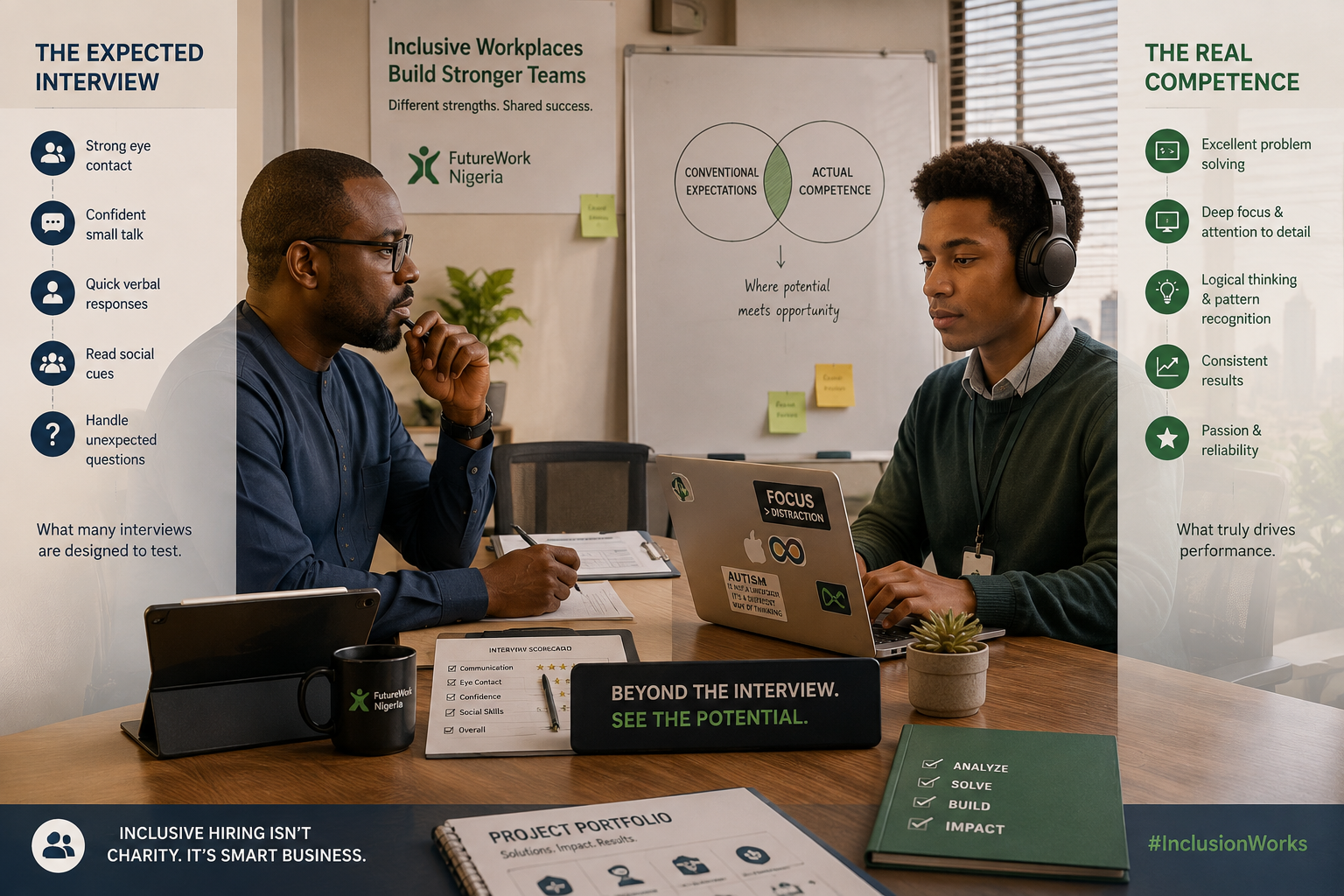
Conventional recruitment processes lean heavily on social and communication behaviours that often have little to do with whether someone can actually perform the job. Think about what a typical interview asks of a candidate: maintain eye contact, respond instantly to unfamiliar questions, read subtle social cues, make easy small talk, project confidence, and navigate an unstructured conversation with strangers. Now ask: does performing well at any of that genuinely predict whether someone can analyse data, write software, manage accounts, design a product, repair equipment, or run a piece of research?
For some autistic candidates, the conventional interview becomes less a test of job competence and more a test of social performance. A recent examination of autism across the employment lifecycle identifies interviews as a significant barrier, pointing specifically to mismatches between typical interview expectations and autistic communication and social styles.
That mismatch doesn’t disappear once someone is hired, either. Are job descriptions clear about what a role genuinely requires, or do they lean on vague phrases like being a “people person” or having “excellent interpersonal skills”?
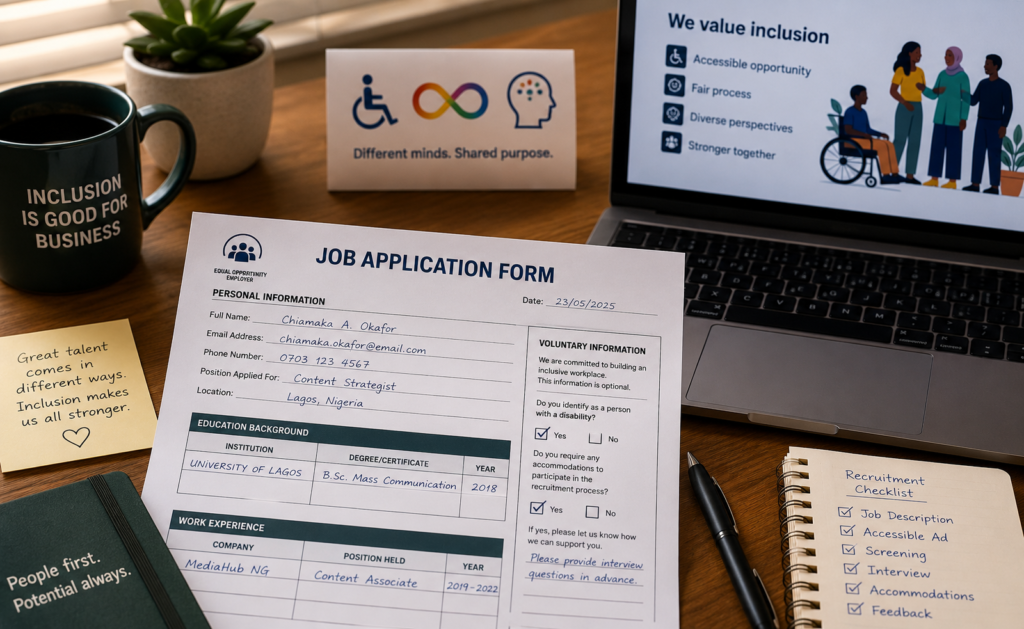
Are instructions given only verbally, when a written version might be far easier to process and act on? Is anyone thinking about sensory conditions such as background noise, harsh lighting, or crowded open-plan spaces? Can an employee actually ask for a reasonable adjustment without fearing it will be held against them?
These aren’t hypothetical concerns. Research on workplace accommodations for autistic adults consistently identifies communication adjustments, flexible scheduling, quieter working conditions, and general workplace awareness as some of the most requested and most effective forms of support. A 2025 systematic review published in Cureus examined a decade and a half of empirical studies on this exact question and found that accommodations — grouped broadly into assistive technology, sensory and organisational adaptations, supervisory support, and psychosocial support — were consistently linked to better job stability, satisfaction and productivity, even though the same review flagged stigma, low awareness and uneven implementation as persistent, ongoing barriers.
When “professionalism” quietly becomes a narrow definition
There’s a subtler issue worth naming here: how workplaces define good performance in the first place.
In many organisations, productivity gets tangled up with visible social behaviour. The colleague who speaks up constantly in meetings reads as “engaged.” The one who holds steady eye contact reads as “confident.” The one who loves networking gets credit for strong “people skills.”
But visibility isn’t the same thing as productivity. Someone who communicates differently may still produce excellent work. Someone who prefers written instructions may simply be highly organised. Someone who finds an open-plan office overwhelming may genuinely perform better somewhere quieter. Someone who skips the after-work social events may still be an excellent colleague and a highly effective employee.
Research centred on autistic workers’ own accounts of their working lives makes this point clearly, identifying the disabling effect of workplaces designed almost entirely around neurotypical social expectations and calling for far more attention to changing the workplace itself rather than placing the whole burden of adaptation on the autistic employee.
None of this means every workplace has to accommodate every individual preference or that every difficulty an autistic employee experiences is automatically the employer’s fault. Jobs have genuine requirements, and every employee — autistic or not — has genuine responsibilities. What it does mean is that the way work gets organised can either quietly create unnecessary barriers or quietly remove them. The choice, more often than not, is a design choice, not an inevitability.
It would also be equally unhelpful to swing the other way and treat autistic workers as though they secretly possess extraordinary hidden talents in maths, technology, or attention to detail, a stereotype almost as reductive as the negative ones.
Some autistic people do have particular strengths in these areas; many don’t. Autism covers considerable diversity, and the case for inclusion shouldn’t rest on the idea that autistic employees are undiscovered “geniuses.” They shouldn’t have to be exceptional to deserve a fair shot.
An autistic applicant should be considered because they’re qualified. An autistic employee should be retained because they perform the role effectively. And where a reasonable adjustment removes an unnecessary barrier, that adjustment is simply part of building an accessible workplace, not a special favour.
The missing piece: Employer and manager knowledge
It’s easy for conversations about autistic employment to place almost all the responsibility on the autistic person: improve your interview skills, practise eye contact, get better at networking, and learn how to behave in a room full of strangers. Some preparation can genuinely help. But inclusion can’t work if only one side is expected to adapt. Employers, recruiters, and managers need knowledge too.
They need to understand that an autistic employee who communicates differently isn’t necessarily disengaged. Someone who avoids eye contact isn’t necessarily lacking confidence. Someone who prefers written instructions isn’t necessarily being difficult. Someone who finds a noisy, open-plan office overwhelming isn’t necessarily unable to work under pressure. These differences need to be understood individually, rather than filtered through stereotype.
Research on autistic employment consistently identifies employer and supervisor education as an important facilitator of sustainable employment, alongside career support and workplace accommodations.
Other studies have also found that structured employment support can benefit employers as well as autistic employees by improving workplace knowledge and communication on both sides. This matters because an autistic employee’s needs aren’t necessarily static. Someone may need more structure while learning a new role and less as they settle in; needs can shift again as responsibilities, teams, or working conditions change.
Autism inclusion, in other words, can’t be reduced to teaching autistic people how to fit into workplaces exactly as they already are. Nigerian employers have a genuine role to play in making those workplaces more accessible in the first place, and that means moving past general awareness and into recruitment practices, workplace culture, management style, and reasonable accommodation.
What Nigerian law actually says about disability and employment
Nigeria isn’t starting from zero here, and it’s worth being precise about what the law actually provides, because rights on paper and rights in practice are two different things.
The central piece of legislation is the Discrimination Against Persons with Disabilities (Prohibition) Act 2018. The Act established the National Commission for Persons with Disabilities (NCPWD) and gave it responsibility for protecting, promoting, and enforcing disability rights, including monitoring compliance with the Act itself. For autistic Nigerians specifically, the significance is straightforward: autism doesn’t sit outside the protections available to persons with disabilities simply because it isn’t always visible at a glance.
In employment terms, the Act addresses opportunities for employment and participation in public life and requires organisations to allocate a proportion of their employment opportunities, commonly cited as at least 5%, to persons with disabilities. That moves disability inclusion beyond corporate goodwill and into the realm of a legal right and an equal-opportunity obligation. The NCPWD’s enforcement function specifically covers disability employment quota enforcement.
There are also concrete signs of the policy conversation moving toward practical support rather than principle alone. In January 2025, the NCPWD, working with Sightsavers and TAF Africa, launched the Framework for the National Access to Work Scheme, intended to remove barriers to formal employment through work-assistive devices and technology, described by the Commission as a “shared responsibility” between government and private-sector employers.
At the scheme’s inauguration, NCPWD Executive Secretary Ayuba Gufwan noted that the initiative seeks to promote inclusive economic participation for over 35.5 million Nigerians with disabilities, while acknowledging that legal frameworks alone haven’t been enough to dismantle the systemic barriers many still face.
Rights on paper are not the same as access to work
This is where the picture gets more complicated. Having a legal right to non-discrimination doesn’t automatically mean an autistic applicant will walk into an inclusive recruitment process.
A law can prohibit discrimination while an applicant still struggles through an interview built almost entirely around conventional social behaviour. An employer can genuinely support disability inclusion in principle while having no actual process for discussing workplace adjustments in practice.
That distinction, between formal rights and practical access, sits at the heart of the autism conversation specifically. An autistic job seeker holds the same legal protections as any other person with a disability. But if employers don’t understand autism, if recruitment stays rigid, or if reasonable workplace adjustments simply aren’t available, that legal right becomes much harder to exercise in real life.
The international human-rights framework backs up why this distinction matters. Article 27 of the UN Convention on the Rights of Persons with Disabilities recognises the right of persons with disabilities to work on an equal basis with others and explicitly covers recruitment conditions, career advancement, vocational training, entrepreneurship and reasonable accommodation, not just the initial act of being hired. That’s a useful benchmark for thinking about autism in Nigeria: employment inclusion was never only about getting someone into a job.
It’s about access to the whole employment lifecycle, entering the labour market, staying employed, developing professionally, and progressing on an equal footing with everyone else.
We can’t fix what we don’t measure
If Nigerian law provides a framework for disability inclusion, the next question is whether we actually have enough information to know who’s being included, who’s being left behind, and why.
Right now, that picture is genuinely difficult to see. The NBS Labour Force Survey collects valuable data on disability alongside broader employment indicators, but its published categories can’t tell us the specific story of autistic Nigerians.
We can’t yet confidently answer questions as basic as “How many autistic adults are employed? How many are actively looking for work? How many are underemployed, working well below their qualifications? Which industries actually employ autistic Nigerians? How many autistic graduates successfully move from education into employment? How many autistic employees receive any workplace accommodation at all? And how many leave jobs because of barriers that could have been fixed?”
We can’t answer most of these with any confidence today. That absence doesn’t mean autistic Nigerians aren’t working. It means their participation in the workforce is currently very hard to see in the data we have.
Why broad disability data isn’t enough on its own
There’s real value in collecting disability-disaggregated employment data. It reveals broad patterns of exclusion and helps policymakers understand disabled Nigerians’ economic participation as a whole. But autism can quietly disappear inside that larger category.
An autistic university graduate might simply be counted as “a person with a disability” or might not identify with disability categories in the same way at all.
A headline employment figure might tell us someone is “employed” without telling us whether they faced discrimination during recruitment, whether they needed adjustments, whether they’re working in their actual field, or whether they accepted insecure, poorly paid work because conventional recruitment repeatedly shut them out of roles matching their qualifications. Two people can both be classified as employed while having completely different experiences of the labour market, and a single statistic won’t tell us which is which.
This is precisely why Nigeria needs its own evidence, rather than borrowing conclusions wholesale from the United States, the United Kingdom, or other high-income countries. International research on autism and employment is genuinely valuable for shaping the right questions, but Nigeria has a different labour market, different levels of formal employment, different educational and vocational pathways, and a much larger informal economy.
A statistic about workplace accommodations in the UK doesn’t tell us how an autistic graduate in Lagos actually navigates the Nigerian job market. International evidence can inform the questions Nigeria asks. Nigerian data has to provide the answers.
Measurement, in other words, isn’t a dry technical afterthought; it’s part of inclusion itself. If policymakers don’t know how many autistic adults are participating in the labour market, they can’t properly assess whether existing employment programmes are actually reaching them. If employers don’t track where candidates are being lost during recruitment, they may never notice their own process is quietly creating the barrier. And if autistic graduates simply disappear from the data the moment they leave school, the entire transition from education to employment stays largely invisible, which brings us right back to where Part 1 of this series started.
Frequently Asked Questions: Barriers, law, and data
- What are the biggest barriers to autistic employment in Nigeria?
Stigma and misconceptions about what autistic people can do, recruitment processes that reward social performance over job competence, a lack of workplace accommodations, and limited employer knowledge about autism are the most consistently cited barriers, both in Nigerian and international research.
- Does Nigerian law require employers to hire people with disabilities, including autistic people?
The Discrimination Against Persons with Disabilities (Prohibition) Act 2018 requires organisations to allocate a proportion of employment opportunities, commonly cited as at least 5%, to persons with disabilities and prohibits discrimination based on disability more broadly, which includes autism.
- Can an autistic employee in Nigeria legally request workplace adjustments?
There is a legal and policy basis for this through the Discrimination Against Persons with Disabilities (Prohibition) Act 2018 and the NCPWD’s National Access to Work Scheme. In practice, whether a specific employer has a clear, accessible process for discussing adjustments varies considerably from one organisation to another.
- Why don’t we have solid national data on autistic employment in Nigeria?
The NBS Labour Force Survey collects broad disability data, but its categories aren’t detailed enough to isolate autism specifically. Combined with a Nigerian research base that has historically focused on children rather than adults, this leaves a significant gap in what we know about autistic Nigerians’ working lives.
This is Part 2 of a three-part series on autism and employment in Nigeria. Part 1 looked at why autistic adults are missing from the national employment conversation in the first place. Part 3 looks at what an autism-inclusive Nigerian workplace could look like in practice.