
Where are autistic adults in Nigeria’s jobs conversation?
Nigeria’s employment conversation is dominated by urgent, legitimate questions such as: How do we reduce unemployment? How do we create jobs for young people? How do we make graduates more employable? How can skills development, entrepreneurship, and workplace diversity strengthen the economy?
Disability inclusion is slowly becoming part of that conversation too. And yet there’s one group that keeps slipping through the cracks of it: autistic adults.
I find that absence striking, because autism doesn’t end when childhood does. Autistic children become autistic teenagers and then autistic adults, some of whom will need substantial lifelong support and many of whom will go on to university, into professional careers, into trades, and into businesses of their own. Like anyone else, autistic adults want financial independence, meaningful work, and the chance to build a career. So where are they in Nigeria’s employment conversation?
Autism doesn’t end in childhood, so why does the conversation?
Globally, autism is far more common than most people realise. A major 2024 analysis published in The Lancet Psychiatry, drawing on the Global Burden of Disease Study, estimated that roughly 1 in 127 people worldwide were autistic in 2021, around 61.8 million people. The World Health Organization’s own autism fact sheet confirms this figure and notes that autism is often not diagnosed until much later in life, even though its characteristics can usually be detected in early childhood.
What that fact sheet also makes clear is something easy to overlook: the abilities and needs of autistic people vary and can evolve over time. Autism isn’t something a person “grows out of;” it is lifelong.
Nigeria’s own research, though, has historically focused overwhelmingly on children. A widely cited scoping review of autism research in Nigeria, published in the journal Autism, mapped everything written on autism in the country up to 2017 and found the evidence base concentrated heavily on childhood prevalence, clinical characteristics, and awareness, with very little attention paid to adolescents, adults, employment, or social policy. More recent Nigerian scoping work on children aged 2–17 has continued to describe legislative and awareness gaps, even as prevalence estimates rise.
That gap matters enormously. If the dominant national conversation about autism is diagnosis, therapy, special education, and caregiving, what happens once an autistic child turns 18? Where do they show up in discussions about graduate employment, skills acquisition, recruitment, or economic participation? Right now, mostly, they don’t.
What Nigeria’s labour force data actually shows
Nigeria does collect labour-market data that includes disability. The National Bureau of Statistics’ Labour Force Survey includes a dedicated set of disability questions, and its published reports show a stark divide between disabled and non-disabled working-age Nigerians: people classified as having a disability are far more likely to sit outside the labour force altogether, far less likely to be in formal, salaried employment, and overwhelmingly concentrated like most Nigerian workers in informal work.
But here’s the catch: none of that tells us anything specific about autistic adults. The survey’s disability categories are broad. They can tell us how disabled Nigerians as a whole are faring in the labour market, but they cannot isolate autism as a distinct experience. Being counted inside the wider “persons with disabilities” category is not the same thing as being visible to employment policy. A number that includes everyone tells us very little about anyone in particular.
That’s a crucial distinction to hold onto, because it shapes everything else in this conversation. We don’t currently have a reliable national answer to basic questions like, how many autistic Nigerians are employed? How many are actively job-hunting? Which industries take them on? We’re working with a genuine blind spot.
From “Can autistic people work?” to “Are our systems built to see them?”
There’s a lazy version of this conversation that starts and ends with one question: can autistic people work? It’s the wrong starting point, and international research bears that out repeatedly.
The problem isn’t a lack of skill or a lack of willingness. It’s how employment systems are designed. Research into autistic adults’ employment experiences consistently points to difficulties around recruitment processes, unwritten social expectations, sensory environments, communication styles, whether or not to disclose a diagnosis, and whether appropriate support is even available once someone is hired. A 2025 systematic review of workplace accommodations for autistic employees, published in Cureus, looked at a decade and a half of empirical studies and found that accommodations, including assistive technology, sensory and organisational adjustments, supportive supervision, and individually tailored arrangements, were consistently linked to better job acquisition, stability, satisfaction, and productivity. The barrier, in other words, usually isn’t the autistic worker. It’s the absence of a workplace built to let them succeed.
So the better question for Nigeria isn’t “Can autistic people work?” It’s: are our recruitment processes, our workplaces, and our employment policies actually designed to recognise autistic talent?
That reframing changes what we look at. Does a job interview measure someone’s ability to do the actual job, or does it quietly reward eye contact, quick verbal responses and easy small talk — things that may have very little to do with whether someone can analyse data, write code, manage accounts, design a product, fix equipment, or run a research study? Are employers ready to make reasonable adjustments? Do workplaces understand sensory sensitivity, different communication preferences, and the value of clear, explicit structure? And, importantly, do Nigeria’s existing disability-employment programmes even think about autism specifically, or does autism disappear inside a much broader disability category?
What happens when an autistic child turns 18?
In Nigeria, public conversation about autism tends to begin and often end with childhood. That focus is understandable. Conversations about diagnosis, early intervention, therapy, schooling, and carer support are genuinely essential, especially in a context where awareness and access to assessment remain uneven across the country. But there’s a question that gets asked far less often: what happens when that autistic child turns 18? Or 25? Or 45?
International research has described adult autism service provision as being, in comparison to children’s services, still in its infancy, a description that applies at least as much to Nigeria as anywhere else. For an autistic Nigerian reaching adulthood, the nature of the challenge changes without becoming any less significant. The questions shift from, Where can this child get a diagnosis? Or which school can support them? Can I find work? Can I earn a living? Can I live independently? Will an employer understand me? What happens if I need an adjustment once I’m hired?
These aren’t side issues. Employment is tightly bound up with independence, social inclusion, self-worth, and quality of life for autistic adults just as much as for anyone else.
Nigerian research has already flagged the consequences of this gap directly. The scoping review mentioned above noted that adults with autism and intellectual disability in Nigeria can face outright exclusion from employment opportunities, including cases where qualified people are kept out of available positions because of stigma and discrimination. The same review pointed to the absence, at the time, of any established national research or social-policy direction specifically addressing autism across the lifespan.
In practical terms, that means the transition from childhood to adulthood becomes a kind of policy blind spot. A child usually has parents advocating for a diagnosis, therapy or a place in an appropriate school. But once that child becomes an adult, responsibility shifts toward systems that are, frankly, much less prepared to respond: employment services, vocational training programmes, universities, employers, HR departments, professional bodies and social-protection schemes. Very few of these systems in Nigeria currently have autism on their radar in any structured way.
From early intervention to a lifelong conversation
The issue isn’t that Nigeria talks too much about autistic children. Early diagnosis and intervention are genuinely important, and that work should continue. The challenge is that the conversation so rarely follows autistic people into adulthood. Autism advocacy shouldn’t stop at diagnosis or early intervention; it needs to ask what happens across the whole lifespan, including the transition from education into employment, vocational development, recruitment, workplace support, career progression, and long-term economic independence.
International employment research backs this shift up. Researchers studying autistic adults’ employment outcomes have argued for a move away from simply getting someone into a job toward supporting long-term employment, professional development, workplace inclusion, and overall quality of life, and they’re clear that employment readiness isn’t something only the autistic individual has to acquire. The wider employment environment matters just as much.
More recent research grounded in the lived experience of autistic workers themselves makes a related point from another angle: rather than assuming autistic employees must simply adapt to workplaces built entirely around neurotypical expectations, researchers have called for far more attention to be paid to workplace acceptance, awareness, and structural adaptation.
That’s an important distinction for Nigeria specifically. If the dominant question stays “How do we prepare autistic people for work?”, the responsibility sits almost entirely on the individual.
But if the question becomes “How do we make employment genuinely accessible to autistic people?”, responsibility is shared by employers, recruiters, policymakers, and the employment programmes meant to serve them. That single reframing shifts the burden from fixing the person to examining the environment they’re being asked to work inside.
It also makes employment a legitimate, central part of autism advocacy rather than an afterthought. An autistic teenager shouldn’t only be asked what support they need to get through school. We should also be imagining what comes next: university, an apprenticeship, a first job, a professional qualification, a business of their own, a promotion, an actual career. The goal of inclusion was never to help autistic people become less visibly autistic or merely more tolerable within systems designed around everyone else. The goal has to be building systems in which autistic people can participate, contribute and build genuinely meaningful lives, including through work.
Nigeria already has a legal foundation. The question is visibility
It’s worth saying clearly, Nigeria isn’t starting from a blank page on disability rights. The Discrimination Against Persons with Disabilities (Prohibition) Act 2018 prohibits discrimination on the basis of disability, and it established the National Commission for Persons with Disabilities (NCPWD), whose mandate includes promoting employment opportunities and enforcing a disability employment quota.
In January 2025, the NCPWD, working with partners including Sightsavers and TAF Africa, launched the Framework for the National Access to Work Scheme, designed explicitly to help remove barriers that keep persons with disabilities out of meaningful formal employment, partly by supplying work-assistive devices and technology to private-sector employers under a “shared responsibility” model.
That’s genuine progress, and it matters. But having a disability policy and having an autism-inclusive policy are not automatically the same thing. An organisation can be fully committed to diversity in principle and still design its recruitment process around assumptions that quietly disadvantage neurodivergent candidates. A person can hold real qualifications and real skills and still struggle to demonstrate either of those things in a conventional interview. I know this from the inside, not just from the research.
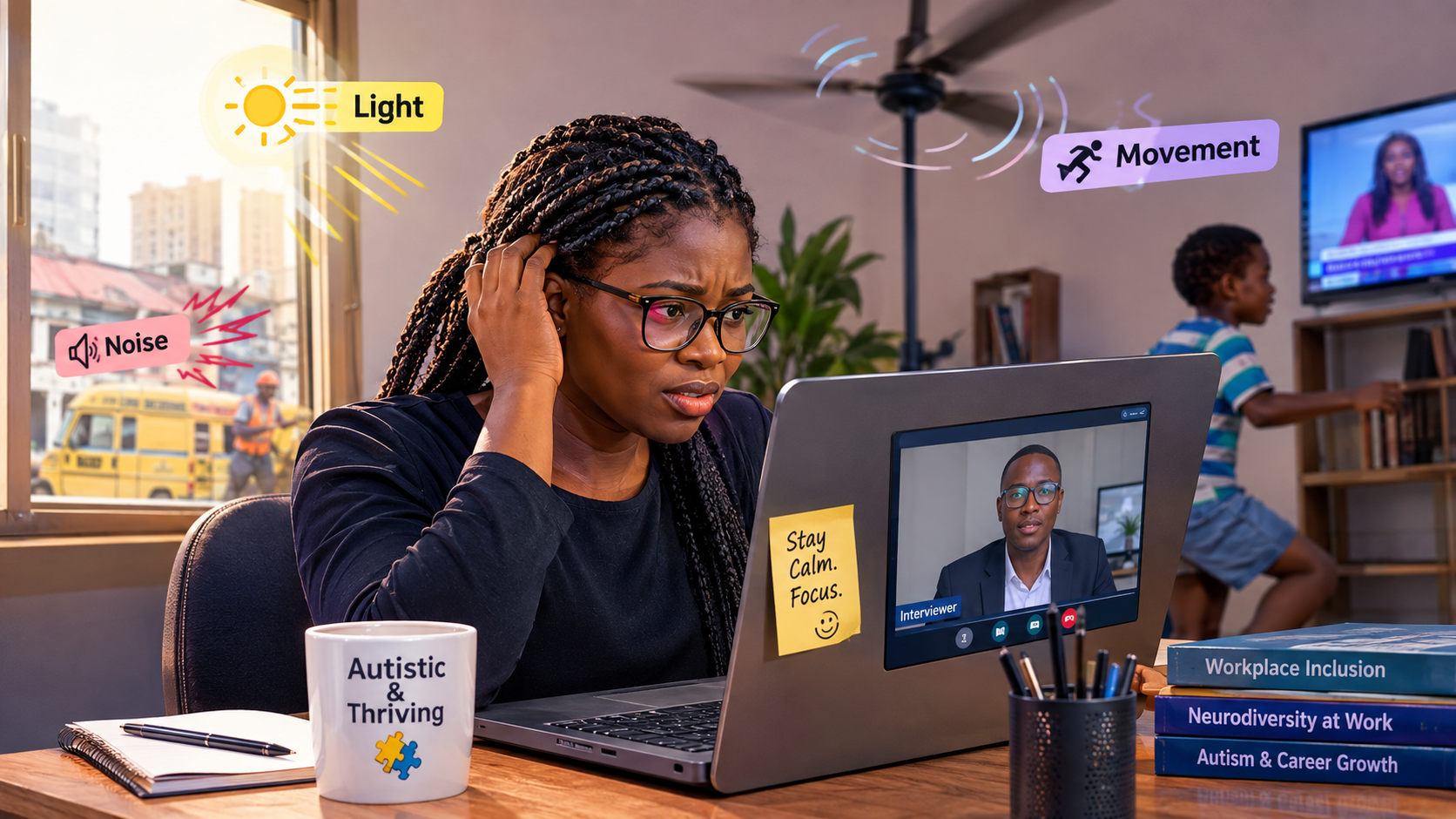
I remember a recent interview where I was the interviewee, not the interviewer. It was conducted online, and the environment I was in wasn’t sensory-friendly. That wasn’t the interviewer’s fault. But every noise, every flicker of light, every small movement competing for my attention added to my anxiety in a way that had nothing to do with my ability to do the job I was being interviewed for.
As I always do, I told the interviewer during the introduction that I’m autistic. Disclosure is a policy I live by with a potential employer, and honestly with anyone I build a relationship with. I’d rather name it up front than let someone misread me.
That single interview captures, in miniature, exactly what this conversation is about. A sensory-unfriendly environment isn’t a reflection of my competence. It’s a reflection of a system or an environment that wasn’t built with autistic candidates in mind. Multiply that single interview by however many autistic Nigerians are job-hunting right now, in similarly unaccommodating conditions, and you start to see how a national employment system can quietly exclude capable people without anyone ever intending to.
Why this matters for Nigeria’s wider jobs crisis
This isn’t a niche issue that exists somewhere off to the side of Nigeria’s employment challenges. It’s part of the same question the country is already asking about its wider workforce: who gets recognised, who gets recruited, who gets supported, and who gets the chance to actually thrive?
Autistic Nigerians are not a small, easily ignored footnote. Given global prevalence estimates of roughly one in 127 people and a national population north of 200 million, we are almost certainly talking about a working-age population in the hundreds of thousands, if not more, most of them currently invisible in national employment data, national employment policy, and the public conversation about jobs.
The question isn’t really whether autistic Nigerians can work. Many already do as professionals, entrepreneurs, tradespeople, and everything in between. The real question, the one this article keeps returning to, is whether Nigeria’s workplaces are ready to see them.
It’s also worth being careful about how this conversation is framed. It would be inaccurate to say Nigeria has no employment opportunities at all for autistic people. Autistic Nigerians are working, building businesses, and developing careers, just as there are employers and organisations already making real efforts toward inclusion.
The more defensible, and more useful, argument is that autism-specific employment data and visibility remain limited. When we can’t clearly see autistic adults in labour-market data, in policy discussions, or in mainstream employment programmes, it becomes very difficult to know whether the systems we already have are actually working for them or simply overlooking them by default.
Frequently Asked Questions: Autism and employment in Nigeria
Can autistic adults work in Nigeria? Yes. Autism is a spectrum, and autistic adults bring a huge range of educational backgrounds, skills, communication styles, and career interests. Some may need substantial support; many need little or none. The more useful question isn’t whether autistic people can work in general, but whether Nigeria’s recruitment systems and workplaces give them a fair chance to show what they can do.
How common is autism, globally and in Nigeria?
The most recent global estimate put autism prevalence at roughly 1 in 127 people worldwide. Nigeria doesn’t yet have a robust, nationally representative adult prevalence figure of its own, most existing Nigerian research has focused on children rather than working-age adults, which is itself part of the problem this series explores.
Does Nigerian labour-market data tell us how many autistic people are employed?
Not with any precision. The NBS Labour Force Survey collects disability data, but its categories are too broad to isolate autism as a distinct employment experience. Autistic Nigerians are counted within the general disability statistics, but they aren’t separately visible within them, which makes it hard for policymakers, employers, or advocates to track whether things are actually improving over time.
Does Nigeria have laws protecting autistic workers from discrimination?
Yes. The Discrimination Against Persons with Disabilities (Prohibition) Act 2018 covers all forms of disability, including autism, and the National Commission for Persons with Disabilities enforces it, including a disability employment quota. Whether that legal protection translates into genuinely accessible recruitment and workplaces in practice is a separate question, one we look at closely, in detail, in Part 2 of this series.
This is Part 1 of a three-part series on autism and employment in Nigeria. Part 2 looks at what’s actually keeping autistic Nigerians out of the workforce and what the law does and doesn’t guarantee in practice.