

Can autistic adults live alone? Rethinking what independence really means
The first time I lived independently, I wasn’t actually alone. I was surrounded by people. For five years at university, I lived in a hall of residence. Every year came with a new set of roommates. In my quietest year, I shared a room with three other people. In my busiest year, there were six of us.
Every year meant starting all over again with strangers, people with different sleeping habits, different ideas of what “clean” meant, different routines, different phone calls, different visitors, and completely different ways of doing things.
If you’ve never experienced it, try to imagine what that feels like: living away from home while sharing your space with three to five new people every year. It took some getting used to. I had to figure out whose alarm would go off first, which shelf was mine, when someone needed quiet, and how to say, “Please, could we keep it down?” without turning it into an argument.
Some years were easier than others. But I adjusted. And then, the following year, I did it all over again.
After university, I moved in with a few colleagues while I was working as an intern. We shared a home, and in many ways, I benefited from having other people around. We shared meals, and they helped with some of the small but important things that, as a new graduate, I hadn’t quite learnt to plan or budget for.
That arrangement lasted about six months. It wasn’t a long time, but it taught me something I didn’t have the words for then: I was independent, and I was also being supported.
Those two things could exist at the same time. A few years later, I finally lived alone. My own apartment. My own keys. My own space. My own quiet. But even then, living alone didn’t mean doing everything alone.
For the 15 months I lived by myself, someone else went to the market to buy my foodstuff. During the first few months, I ate out most of the time because cooking simply wasn’t part of my routine yet. Then my sibling visited one day and brought me foodstuff. That small gesture changed something. I decided to start cooking.
It didn’t happen overnight. I started slowly, one meal at a time, and gradually built a kitchen routine that hadn’t existed before. Looking back now, I sometimes wonder: which of those chapters was “independent living”?
Was it the university hall, where I lived with three to five other people? Was it the house I shared with colleagues, where we relied on each other in practical ways? Or was it the apartment where I had my own keys and lived by myself, even though someone else still helped me with something as basic as buying foodstuff? I would argue that all of them were independent living.
And that is the idea behind this series.
When we talk about autistic adults living independently, we often imagine one very specific picture: a person living alone, managing everything themselves, cooking every meal, paying every bill, keeping the house spotless, getting everywhere on their own and needing little or no help.
Real life is rarely that simple. Independence isn’t necessarily about doing everything without help. Sometimes it means having the freedom to make your own decisions while getting the right support to make those decisions work.
For some autistic adults, that might mean living alone. For others, it might mean living with roommates, a partner, family members, or in supported accommodation. It might mean having someone help with shopping, cooking, finances, transportation or household tasks while still having control over your own life.
So the better question may not be, “Can an autistic adult live completely independently?” It may be, “What does independent living look like for this particular person, and what support would help them thrive?” That is what we’ll be exploring in this series.
Can autistic adults live alone?
One of the most common questions autistic adults and their families ask is, ‘Can autistic adults live alone?’
The short answer is yes. Many autistic adults live independently and successfully manage their own homes, finances, routines, and daily responsibilities. At the same time, independent living genuinely isn’t the right fit for everyone, and it doesn’t need to be. Some autistic adults thrive with roommates. Some thrive with a partner. Some thrive living with family or with structured support services helping them navigate specific challenges. None of these is lesser versions of independence. They’re just different shapes of it.
That framing matters because the research paints a fairly stark picture of what actually tends to happen. The National Autism Indicators Report: Transition Into Young Adulthood, produced by Drexel University’s A.J. Drexel Autism Institute using nationally representative U.S. data, found that only around 19% of autistic young adults had ever lived independently without supervision in the years after leaving high school, compared with the vast majority who spent at least some time living with a parent or guardian.
A related peer-reviewed study by Kristy Anderson and colleagues, published in the journal Autism, put the figure even lower, at around 17%, and found autistic young adults were markedly less likely to live independently than peers with intellectual disability.
I share those figures not to suggest independent living is unusual or unrealistic for autistic adults — many of us do it, myself included — but because they say something important about how few of us are ever actually asked what kind of independence would work for us, versus simply being pushed toward, or held back from, one narrow version of it.
Independence is not an all-or-nothing concept
It’s worth sitting with that idea for a moment, because so much confusion about autism and independent living comes from treating it as binary. Either you live completely alone and handle everything yourself, or you’re “dependent” and need looking after. That picture doesn’t hold up under any real scrutiny.
Living independently can look wildly different from person to person. One individual may manage every single aspect of daily life entirely on their own. Another may live entirely alone in their own flat while receiving regular help with budgeting, transportation, healthcare appointments, or household tasks, much like I did with my groceries while I lived alone. Both of those situations represent successful, meaningful independence. Neither is a watered-down version of the other.
Autism itself doesn’t determine whether someone can live alone. What actually shapes the answer is a combination of factors: daily living skills, support needs, physical and mental health, financial stability, access to community resources, and, just as importantly, personal preference.
Rather than asking whether a person is “independent enough”, a genuinely more useful question is this: what living situation best supports their safety, wellbeing, happiness, and long-term goals?
What does “independent living” actually mean?
When most people hear the phrase “independent living,” they picture someone living entirely alone, handling every responsibility solo, never relying on another person for anything. That image fits some people. It’s just one version among many, not the definition itself.
A more accurate way to think about independence focuses on choice, autonomy and self-determination, not on whether a person completes every single task without any help whatsoever. Independence is about having control over your own life and your own decisions. It is not, and was never really meant to be, about doing everything without help.
This distinction matters enormously in practice, because family members, caregivers, and even autistic adults themselves sometimes assume that accepting support automatically means someone “isn’t truly independent.” In reality, most successful adults, autistic or not, rely on some form of assistance while maintaining full control over the direction of their own lives.
There’s a growing body of thinking in disability advocacy that pushes this even further, arguing that the whole cultural obsession with total, unaided self-sufficiency is itself the problem, rather than a useful standard to measure anyone against.
The disability justice organiser Mia Mingus has described interdependence, not independence, as the real goal, pointing out that no one is ever truly independent in the way the word is often used, and that what actually matters is having control over the big decisions in life: who you live with, how you spend your time, who you rely on, and who relies on you in return.
Writers exploring neurodivergence and daily living skills have made a similar point: balancing independence with support isn’t a compromise on independence. For many neurodivergent adults, it’s what actually makes a stable, sustainable adult life possible in the first place.
The many shapes independent living can take
Before going further, it’s worth briefly naming the range of arrangements that all genuinely count as independent living, because Part 2 of this series looks at each of these in far more depth.
- Living completely alone
For some autistic adults, this means having their own home or apartment without housemates or family. It often means greater privacy, more control over the sensory environment, and freedom to build personal routines from the ground up.
It also typically means directly managing bills, groceries, meal preparation, household maintenance, appointments, and transport, though, as my own experience shows, “directly managing” doesn’t have to mean managing entirely alone.
- Living with roommates
Sharing a home can reduce living costs, provide built-in social connection, and create a natural way to split household responsibilities. For someone who values both independence and a level of daily companionship or practical backup, this can be a genuinely effective middle ground, which is exactly what those five years of hall-of-residence life taught me, long before I ever lived alone.
- Living with a partner
Sharing a home with a romantic partner or spouse is still independent living. Responsibilities usually get divided according to each person’s strengths, and interdependence — supporting one another while each maintaining personal autonomy — is a completely normal feature of healthy adult relationships, autistic or not.
- Living with family while managing real responsibilities
There’s a persistent myth that living with parents or siblings as an adult automatically means dependency. In practice, many autistic adults living with family hold down jobs, manage their own finances, keep their own medical appointments, and make their own decisions, while simply sharing a roof and occasional support with people they trust.
- Supported housing
Some autistic adults benefit from arrangements that provide a defined level of assistance, including help with budgeting, medication management, transportation, or daily living skills, while still preserving real autonomy over the rest of their lives.
Organisations such as the National Autistic Society run outreach and community support services precisely along these lines, built around helping autistic adults build confidence and life skills at whatever pace and level of support actually works for them.
Why support needs look so different from one autistic adult to the next
Autism is often described as a spectrum, and that word gets used so often it can start to feel like a cliché. But it’s genuinely the right frame for understanding why independent living looks so different from one autistic adult to the next.
Two autistic people can have the same diagnosis and completely different daily lives: different sensory sensitivities, different communication styles, different strengths in planning and organisation, different levels of comfort with change, different support needs that might shift depending on stress, health, or simply what season of life they’re in.
That variability is exactly why a single national statistic, like the 19% figure mentioned above, can never tell the whole story of any one person. It tells us something true and important about systemic gaps: too few autistic young adults are getting the preparation, the services, or simply the chance to try living more independently before they’re expected to have already mastered it. But it says nothing about what any individual autistic adult is actually capable of, given the right conditions, the right timeline, and the right support.
I think about this a lot when I look back at those five years in halls of residence. Nobody sat me down beforehand and taught me how to negotiate space with three to five new people every year. I built that skill by doing it, imperfectly, again and again, until it became something I could do without quite so much dread.
The same was true of cooking. I didn’t wake up one day in my own flat suddenly able to cook for one person. It took fifteen months, a period of eating out, a sibling’s grocery delivery, and then, only then, a decision to try. None of that makes the eventual outcome less real. It just means the timeline looked like mine, not like anyone else’s.
Sensory environment and autonomy: An underrated piece of the puzzle
One factor that rarely gets enough attention in conversations about autism and independent living is the sensory environment, and how much control over it can shape whether a living situation actually feels sustainable, rather than just survivable.
Many autistic adults experience heightened or different sensory processing: sounds that feel louder than they should, lighting that feels harsher and textures or smells that are genuinely harder to tolerate than they are for a non-autistic housemate.
A living arrangement that ignores this entirely — a loud shared flat with no quiet space, an open-plan family home with constant background noise — can make even simple daily tasks feel exhausting, regardless of how capable someone is on paper.
This is part of why “independence” needs to be judged by outcome, not by appearance. A person managing every task solo in a sensory environment that quietly drains them every single day isn’t necessarily more independent than someone sharing a home with a trusted roommate in a calmer, more predictable space. The measure that actually matters is whether the living situation supports someone’s wellbeing over time, not whether it matches a particular picture of solo self-sufficiency.
A better way to ask the question
One reason conversations about independent living get so confusing is that people quietly compare themselves, or their autistic relative, to an unrealistic standard of complete self-sufficiency that barely exists in real life. Very few adults, autistic or not, do everything entirely unaided.
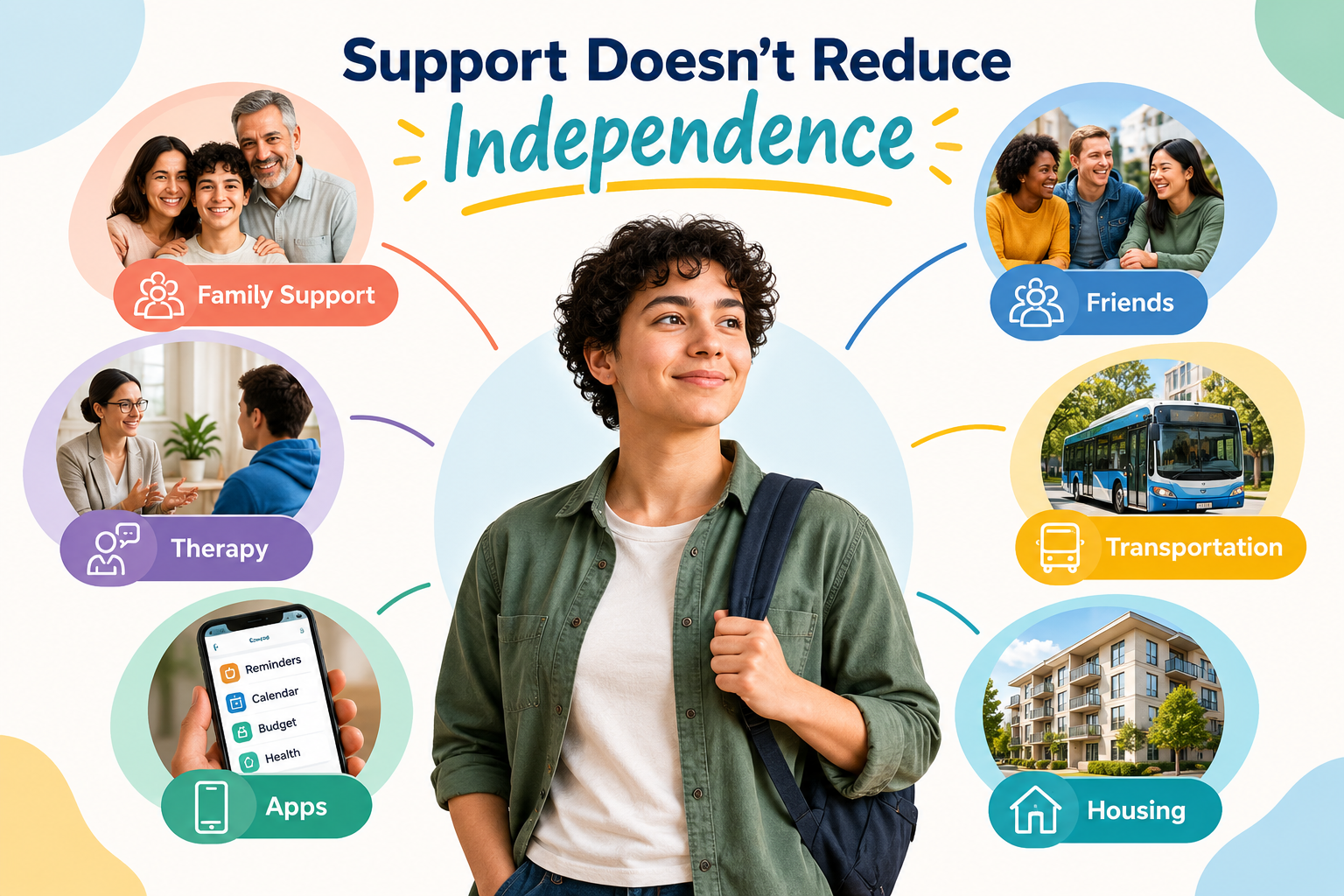
We rely on family, partners, friends, employers, healthcare professionals, community services, apps and reminder systems. Using support systems is simply a normal part of being an adult.
So instead of asking, “Can I do everything by myself?”, it’s far more useful to ask:
- Can I make decisions about my own life?
- Can I manage or arrange, support for my daily needs?
- Can I maintain a living situation that’s safe and sustainable?
- Can I pursue the goals that actually matter to me?
- Do I have the tools and support I need to thrive?
Those questions give a far more honest picture of independence than simply asking whether someone lives alone or completes every task solo. Independent living was never really defined by a particular housing arrangement. It’s defined by the ability to exercise choice, hold onto personal agency, and build a life that fits your own needs, values and goals — whether that life includes a rotating cast of hall-of-residence roommates, a sibling who occasionally does your grocery run, or, eventually, a kitchen where you’ve finally decided to start cooking for yourself.
In Part 2 of this series, we’ll go much deeper into each of these living arrangements, such as the genuine benefits, the genuine challenges, and what tends to make each one work well in practice for autistic adults specifically. And in Part 3, we’ll look at the practical skills that make any of these arrangements sustainable, how to honestly assess your own readiness without turning it into a pass-or-fail test, and how to build confidence gradually, including one meal, one bill, one appointment at a time, the same way I eventually found my way to cooking in that flat.
Frequently Asked Questions: Autism and Independent Living (Part 1)
- Can autistic adults live alone?
Yes. Many autistic adults live alone and manage their homes, finances, and daily routines successfully. Others thrive living with roommates, family, a partner, or with structured support services. The right arrangement depends on the individual, not on autism as a diagnosis.
- Do most autistic adults live independently?
Not yet, according to the available research. The Drexel National Autism Indicators Report found that only around 19% of autistic young adults had ever lived independently without supervision by their early twenties, with the large majority spending at least some time living with a parent. That gap reflects a mix of genuine support needs and limited access to the right kind of preparation and services, not a fixed ceiling on what’s possible.
- Does living alone mean doing everything without help?
No. Living alone describes a housing arrangement, not a level of self-sufficiency. Someone can live entirely alone while receiving regular support with groceries, transport, healthcare appointments or household tasks, and still be living independently in every meaningful sense.
- What’s the difference between independence and interdependence?
Independence, narrowly defined, suggests doing everything without help. Interdependence — a concept increasingly used in disability advocacy — describes relying on others while also being relied upon, and keeping control over the decisions that matter most in your own life. Many disability advocates, including Mia Mingus, argue interdependence is a more honest and more achievable goal than total self-sufficiency for autistic adults and non-autistic adults alike.
- Is it normal for an autistic adult’s living situation to change several times over the years?
Yes, and it’s arguably the norm rather than the exception. Moving from a family home, into shared student housing, into a solo flat, and perhaps into a different arrangement again later isn’t a sign that something has gone wrong; it’s usually a sign that someone is building skills, learning their own preferences, and adjusting their support as their circumstances change.
A living arrangement that works well at 20 doesn’t have to be the same one that works well at 30, and there’s no fixed timetable that every autistic adult is supposed to match. My own path — five years of shifting roommates, then a slow, supported transition into living entirely alone — is one version of that, not a template everyone else needs to follow.
This is Part 1 of a three-part series on autism and independent living. Part 2 looks in depth at the different living arrangements available to autistic adults, including living alone, with roommates, with a partner, with family, or in supported housing like the genuine benefits and challenges of each. Part 3 covers the practical skills involved in independent living, how to know if you’re ready, and how to build confidence gradually over time.