


Key takeaway
- Autism did not suddenly appear in modern times. What has changed is our understanding of it.
- From being misclassified as a symptom of schizophrenia to being recognised as a spectrum and now as part of natural human diversity, our understanding continues to evolve.
- And with that evolution comes responsibility: to move from awareness to true acceptance.
Did you know that autism was once considered a symptom of schizophrenia?
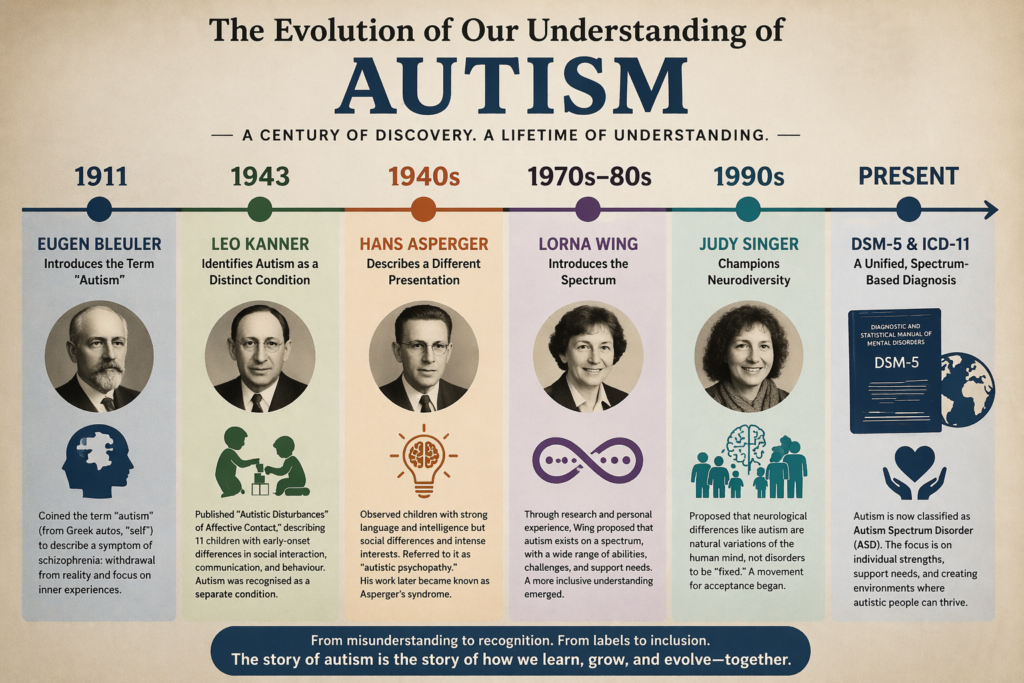
The word “autism” did not originally mean what we understand today. In 1911, Swiss psychiatrist Eugen Bleuler introduced the term while studying schizophrenia, a condition he played a major role in defining. He derived it from the Greek word autos, meaning “self”, and used it to describe a pattern of withdrawal from reality, a deep focus on one’s inner thoughts and experiences.
At the time, autism was not seen as a separate condition. It was understood as a symptom of schizophrenia, particularly linked to social withdrawal and detachment.
A shift begins: Autism as its own condition
This understanding began to change in 1943, largely due to the work of Leo Kanner, an Austrian-American child psychiatrist at Johns Hopkins Hospital.
Kanner carefully studied 11 children who displayed a consistent pattern of behaviours — differences in social interaction, communication challenges, a preference for routines, and intense focus on specific interests. What stood out was that these traits appeared early in life and did not fit existing diagnoses like schizophrenia.
In his landmark paper, “Autistic Disturbances of Affective Contact,” Kanner introduced the concept of “early infantile autism”, arguing that these children were not experiencing schizophrenia but a distinct developmental condition.
This marked a turning point. The first clear recognition of autism as its own diagnosis.
A parallel discovery
Around the same time in the 1940s, Hans Asperger was conducting similar research in Vienna.
He observed children who, unlike those described by Kanner, often had strong language skills and average or above-average intelligence. However, they experienced noticeable differences in social interaction, including difficulty interpreting social cues and forming typical peer relationships. Many also had highly focused interests.
Hans Asperger described the behavioural patterns he observed in certain children as “autistic psychopathy.” It is important to note that the term ‘psychopathy’ carried a very different meaning at the time. In the early 20th century, psychiatrists used it broadly to refer to a personality profile or temperament, a characteristic way of thinking, feeling, or behaving that differed from what was considered typical. It did not have the violent or criminal associations that the word tends to carry today.
In contemporary usage, psychopathy usually denotes a specific personality disorder, often linked with a lack of empathy, manipulative behaviour, and antisocial tendencies. This is quite distinct from Asperger’s original intention.
Crucially, Asperger also drew attention to the strengths of the children he studied, such as excellent memory, logical thinking, meticulous attention to detail, and intense, focused interests. At the time, these positive qualities were largely overlooked, as mainstream psychiatry tended to concentrate almost exclusively on deficits and difficulties.
His work remained relatively unknown internationally until the 1980s, when British psychiatrist Lorna Wing brought attention to it. This led to the popularisation of the term “Asperger’s syndrome”.
However, as understanding evolved, experts recognised that these differences were not separate conditions but part of a broader continuum. The term was eventually folded into the umbrella diagnosis of Autism Spectrum Disorder (ASD).
Understanding the spectrum
Through the 1970s and 1980s, it became increasingly clear that autism does not present the same way in every individual.
Lorna Wing played a key role in reshaping this understanding. Drawing on both her research and her experience as the mother of an autistic daughter, she introduced the idea of autism as a spectrum.
This meant recognising that autistic people can have a wide range of
- Communication styles
- Cognitive abilities
- Sensory experiences
- Support needs
Some individuals may be highly verbal and independent, while others may require significant support. No two autistic people are exactly alike.
This shift away from rigid categories laid the foundation for modern approaches to autism.
The rise of neurodiversity
In the late 1990s, Australian sociologist Judy Singer introduced the concept of neurodiversity.
Until then, autism was largely viewed through a medical lens, focused on deficits and what needed to be “fixed”.
Singer challenged this perspective. She argued that neurological differences, including autism, are part of natural human variation, not abnormalities but differences. Just like variations in personality, ability, or perspective.
This idea reframes autism as a valid way of being, with both strengths and challenges.
The neurodiversity movement has since influenced advocacy, education, workplace inclusion, and broader cultural conversations, shifting the focus from correction to acceptance and support.
Where we are today
In earlier diagnostic systems, several different labels were used to describe autistic presentations. These included autistic disorder, Asperger’s syndrome, and Pervasive Developmental Disorder – Not Otherwise Specified (PDD-NOS). Each term was intended to capture a slightly different pattern of behaviour, abilities, and support needs, but in practice, the distinctions were often inconsistent and confusing.
Modern diagnostic manuals, such as the DSM-5 and ICD-11, have brought these separate categories together under the single umbrella of Autism Spectrum Disorder (ASD). This change reflects a more accurate understanding of autism: rather than being a set of rigidly distinct conditions, autism exists along a spectrum, with a wide range of strengths, challenges, and ways of experiencing the world.
The spectrum approach emphasises that each autistic individual is unique. Rather than trying to fit people into fixed categories or rigid labels, the focus is now on understanding each person’s profile: their abilities, support needs, and the strategies that help them thrive in daily life.
This approach aligns with the principles of neurodiversity by emphasising acceptance, inclusion, and creating environments where autistic people can thrive.