

Why forgetting doesn’t mean you didn’t care: Understanding autistic memory and what actually helps
Key Takeaways
- Memory begins with attention. Without it, information rarely gets encoded in the first place.
- Dopamine helps decide what’s worth paying attention to, and curiosity itself appears to strengthen memory through this exact pathway.
- Motivation changes how the brain learns, not just how willing someone is to try, which is why “special interest” knowledge and “forced” learning rarely stick the same way.
- Forgetting is not a reliable measure of effort, intelligence, or love. It’s usually a sign of how attention, working memory, and executive functioning handled that specific moment.
- Shame and pressure make memory worse, not better, by adding to cognitive load.
- Real support — external tools, visual structure, interest-based learning, and simply not assuming the worst — can make an enormous, practical difference.
In Part One, I explored why autistic memory often seems so contradictory. Through my own experiences and research, I explained that memory isn’t a single system but a collection of different ones, including working memory, episodic memory, semantic memory, and procedural memory.
I looked at why some autistic people can struggle to recall information they read moments ago yet remember extraordinary amounts about subjects they genuinely love.
The previous article explored how attention, monotropism, hyperfocus, and special interests shape what gets stored in long-term memory, showing that autistic memory isn’t “bad” or “broken.” It’s simply organised differently. To understand why, we first need to look at something even more fundamental: attention. Memory doesn’t begin when we try to remember something later. It begins much earlier, with what the brain notices first.
Attention comes before memory
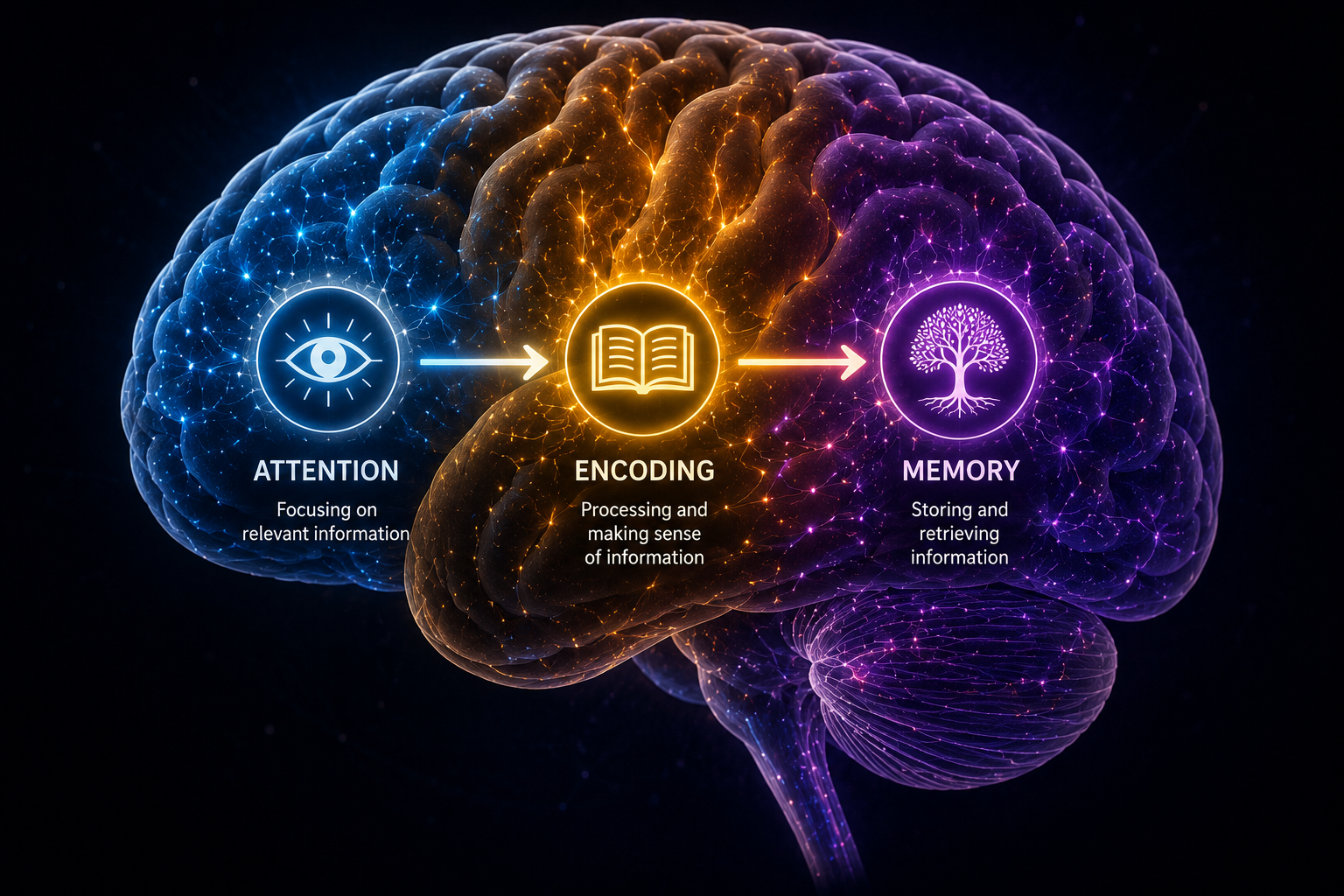
It’s easy to think of memory as something that happens after we learn. In reality, memory starts much earlier, with attention. Before your brain can store information, it has to notice it. If it doesn’t, there may be nothing meaningful to remember later.
You can think of the process like this: Attention → Encoding → Memory
Or, from the opposite direction:
No attention
↓
No encoding
↓
No memory
Encoding is the process of transforming information into a form the brain can store. If that process never happens, the memory simply doesn’t have a chance to form properly.
We experience this all the time. Have you ever driven home and realised you can’t remember passing several familiar streets? Or been introduced to someone, only to forget their name seconds later? Or reached the bottom of a page in a book and realised you have absolutely no idea what you’ve just read? If you haven’t, well, I have.
In those moments, my eyes were surely looking. My ears were listening. But somewhat, my attention wasn’t fully there. Without attention, the brain often doesn’t bother creating a lasting memory.
For many autistic people, this filtering process can be especially pronounced. Information that feels deeply meaningful often receives intense, sustained attention, while information that feels disconnected, repetitive, or unimportant may receive far less.
That isn’t a conscious decision. It’s how the brain allocates its limited resources.
The role of dopamine
One of the key biological systems involved in this process is dopamine. And it is often described as the brain’s “pleasure chemical,” but that’s an oversimplification. A more accurate way to think about dopamine is this:
Dopamine helps the brain decide what is worth paying attention to. It plays a central role in motivation, learning, reward, curiosity, prediction, and reinforcement.
When something is meaningful or unexpectedly interesting, dopamine signalling helps the brain prioritise that experience. It encourages us to keep exploring, keep learning, and remember what we’ve discovered because that information may be valuable in the future.
Crucially, dopamine doesn’t just show up after a reward. Research on curiosity has found it also responds to the anticipation of learning something new or solving a problem, and that this dopaminergic response is directly tied to how well information gets locked into memory. States of curiosity have been shown to modulate hippocampus-dependent learning through this exact dopaminergic circuit, which is part of why the learning itself can feel so compelling, almost addictive, when a topic genuinely grips you.
That’s the mechanism behind special interests pulling you in the way they do. For instance, one new fact about black holes leads to a question about exoplanets, which takes you to another discovery and then another. Each answer reopens the loop. The same cycle applies whether the interest is Pokémon, insects, mediaeval history, or railway signalling. The brain sustains attention, encodes deeply, and keeps strengthening the memory over time.
Why motivation isn’t the same as effort
This is also where a very common and very unfair assumption creeps in: “If they can memorise hundreds of dinosaur species, why can’t they remember their homework?”
That question assumes both tasks are processed in the same way by the brain. However, they aren’t.
Motivation influences how much attention something receives. Attention influences how deeply information is encoded. Encoding, in turn, determines how easily it can be recalled later. These aren’t separate, optional stages. They’re tightly connected parts of the learning process.
Imagine two classroom lessons of equal length. In one, a student is genuinely captivated. They’re asking questions, spotting patterns, and linking new ideas to things they already know. On the other hand, the material feels abstract, disconnected, and difficult to engage with. They try to concentrate, but their attention keeps drifting. Although the same amount of time is spent in both lessons, the quality of learning is unlikely to be the same. The difference isn’t intelligence. It’s how fully the brain engaged with the information in the first place.
This helps explain an experience many autistic people know well: struggling to remember mandatory training, administrative procedures, or classroom content that feels disconnected from anything meaningful, then spending four uninterrupted hours that same evening learning every species of mantis without noticing the time passing. From the outside, that can look inconsistent. From the inside, the brain is simply responding to two very different motivational conditions.
Research increasingly suggests that when learning aligns with genuine interests, people tend to persist for longer, process information more deeply, remember it more accurately, and build richer networks of knowledge. Many autistic people demonstrate this especially vividly through their special interests.
Rather than collecting isolated facts, they often spend months or years developing an interconnected understanding of a subject. Each new piece of information is linked to existing knowledge, creating a dense web of associations that makes future learning easier and retrieval more reliable.
This way of learning also fuels persistence. Challenges that might feel frustrating in other contexts often become enjoyable puzzles when they’re connected to a favourite topic. Questions lead to investigation, investigation leads to discovery, and discovery sparks even more curiosity.
Over time, this cycle can produce an extraordinary depth of expertise. That’s one reason autistic special interests deserve to be seen as far more than hobbies. They can be remarkably powerful learning tools.
They cultivate sustained attention, encourage repeated practice, strengthen long-term memory, and help build highly organised knowledge networks. The same cognitive processes that enable someone to become an expert in astronomy, music theory, history, coding, or insects can also become valuable pathways into education, employment, creativity, and lifelong learning, provided those interests are recognised and supported.
Research into monotropism reinforces this idea. A widely cited 2019 study found that interest-based learning didn’t simply improve how effectively autistic children and young people learned. It also strengthened the relationship between student and teacher, an important factor in maintaining engagement far beyond any individual lesson.
Understanding this shifts the conversation. Instead of seeing autistic interests as distractions from learning, we can recognise them as one of the brain’s most effective gateways to it. For many autistic people, special interests aren’t a barrier to education but one of the most reliable ways in.
The myth that forgetting means you didn’t care
Few things are more painful than forgetting something important and having someone assume it reflects your character. I imagine most autistic people have heard some version of, “You weren’t listening.” “If it mattered, you’d remember.” “You just don’t try hard enough.”
These land hard because they quietly confuse memory with intention. But forgetting something doesn’t reliably tell you how much a person cared. More often, it tells you how the brain processed — or struggled to process — the information in the first place. Okay, just hear me out while I explain.
We tend to use memory as an emotional shortcut. If someone remembers your birthday, they must care. If they remember your favourite coffee order, they must have been paying attention.
If they forget an appointment or something you told them yesterday, it can feel as though they weren’t listening. It’s an understandable assumption. But it’s also inaccurate.
Memory isn’t a perfect record of what matters to us. It’s the product of many interacting processes, often shaped by attention, working memory, executive functioning, stress, motivation, sleep, and the circumstances in which the information was learned, not love alone.
Two people can care equally about the same thing and remember it completely differently. Likewise, the same person can remember one important event in extraordinary detail while completely forgetting another.
That isn’t hypocrisy. It’s how human memory works, and in autism, those differences can be even more pronounced.
Forgetting isn’t a measure of effort
One of the biggest misconceptions about autistic memory is the belief that forgetting means someone wasn’t trying. But these are not the same thing.
Attention isn’t the same as caring. Someone can desperately want to hold onto information while their working memory simply can’t keep it long enough to encode it.
Memory isn’t the same as love. Forgetting a date doesn’t mean the relationship matters less.
Recall isn’t the same as commitment. Struggling to retrieve something doesn’t mean it was never learned, or never mattered.
This is where executive functioning — the brain’s management system for planning, organising, switching tasks, and monitoring multiple things at once — plays a huge role.
Executive functioning differences are common in autism, and importantly, they aren’t part of the diagnostic criteria for autism itself. They’re a closely associated feature, not a defining one, and they show up in a wide range of other conditions, too. Someone can fully understand a task, genuinely care about it, and still forget, not because effort was missing, but because execution broke down somewhere between intention and action.
Think about a student who finishes every homework question correctly the night before, then leaves the workbook on the kitchen table the next morning. A teacher might assume laziness. A more accurate explanation is that the morning routine — getting dressed, packing lunch, finding a PE kit, managing sensory overload on the way to school — simply overloaded working memory before the homework ever made it into the bag. It wasn’t forgotten because it was unimportant. It was forgotten because the brain was juggling too much at once.
The same misunderstanding follows people into adulthood. An employee who forgets a detail from an earlier meeting might get quietly written off as inattentive, while that same person can explain a complex technical process from memory or solve a problem nobody else on the team can crack. These aren’t contradictions. The meeting relied on working memory and task-switching. The technical knowledge came from long-term memory, built over years of genuine interest and repetition. Different systems, doing different jobs.
Even relationships aren’t immune. Forgetting an anniversary can feel deeply personal to a partner, understandably so. But that same person might remember every book by your favourite author, the story of how you first found them, and quietly track down a rare edition you’d mentioned wanting, months later, without being asked. Care was clearly there. It simply expressed itself through a different memory system than the one tracking calendar dates.
Why shame makes memory worse
Here’s the frustrating irony: criticising someone for forgetting tends to make forgetting more likely, not less. Being expected to be judged for mistakes raises anxiety, and anxiety eats into the exact mental resources memory depends on.
Psychologists call this cognitive load, which is the total mental effort your brain is already carrying at any given moment. The higher the load, the fewer resources remain for attention and encoding. Under stress, the brain prioritises managing the immediate emotional situation over carefully filing away new information. That can spiral: someone forgets, gets criticised, and becomes anxious about forgetting again, and the anxiety itself makes remembering harder next time.
A more useful question than “Why didn’t you care enough to remember?” is simply, “What made this hard to hold onto, and what would make it easier next time?” That shift doesn’t erase every missed responsibility. But it recognises something important: memory difficulties aren’t a reliable measure of effort, intelligence, or love.
Why autistic memory looks “inconsistent”, and why it isn’t
Autistic memory can look unpredictable from the outside. From the inside, there are usually understandable reasons behind it. A person who remembers every detail of a favourite subject but forgets an everyday task isn’t running a broken memory system. They’re showing exactly how attention, emotion, and executive functioning decide what gets prioritised.
One of the biggest reasons autistic memory can look inconsistent is that memory is often context-dependent. The brain doesn’t store information in isolation. It stores information alongside the situation, emotions, sensory environment, and mental state connected to it.
This is why someone may remember a fact perfectly when discussing a favourite subject but struggle to recall the same information in a stressful situation, during a rushed conversation, or when they are overwhelmed. The information may still exist. The challenge is accessing it at that particular moment. Several factors can influence this:
- Interest — deeply engaging topics get more repetition, more attention, and stronger encoding than routine information, even when the person understands the routine information matters.
- Emotional salience — meaningful or emotionally charged moments (good or bad) tend to be remembered more strongly than neutral ones.
- Executive functioning — someone can hold excellent knowledge in long-term memory while still struggling to retrieve the right piece of it at the exact moment it’s needed.
- Sensory overload — when the brain is busy managing noise, bright lights, or crowds, fewer resources are left over for encoding anything new.
- Fatigue and stress — both reduce attention and make working memory considerably less reliable.
The pattern isn’t “I remember some things and forget others for no reason.” It’s closer to: my brain remembers information differently depending on how meaningful, accessible, and manageable the moment actually is.
Practical support: What actually helps
Understanding autistic memory shouldn’t stop at explaining it but change how we support it. The goal was never to force every brain to work identically. It’s to build environments where different memory and learning styles can genuinely succeed.
For autistic people
If working memory is unreliable, external supports can reduce the amount of information the brain has to hold at once.
Helpful strategies include:
External memory supports
Use tools that move information out of your head and into your environment.
Examples include:
- Calendars
- Phone reminders
- Alarms
- Written notes
- Task management apps
- Checklists
These aren’t signs of weakness. They are tools that support the brain’s natural limitations. Most people use external supports in some form. Autistic people may simply benefit from using them more intentionally.
Visual schedules
Many autistic people process visual information more easily than spoken instructions alone. Visual schedules, diagrams, written steps, and examples can make expectations clearer and reduce the demand on working memory.
Linking tasks to interests
When possible, connect new information to existing interests. A person who loves trains may learn maths through railway examples.
Someone interested in animals may find biology more engaging through animal-related topics. Someone passionate about languages may learn history through the development of words and cultures. Interest can become a bridge to learning.
Reducing working memory load
Instead of relying on remembering multiple instructions at once:
- Write steps down
- Complete one stage at a time
- Use routines
- Create predictable systems
The aim is not to make someone “try harder” but to design systems that work with the way their brain processes information.
For Parents
A child’s interests are often powerful learning pathways. Instead of seeing intense interests as distractions, parents can use them as tools for development.
A child, for instance, interested in dinosaurs can practise:
- Reading through dinosaur books
- Maths through counting and classification
- Science through fossils and evolution
- Communication through explaining what they know
A child interested in trains can explore:
- Geography through railway maps
- Physics through engineering concepts
- History through transport development
Interests can create motivation, confidence, and opportunities for deeper learning. The question is often not, “How do we get this child interested in what we want to teach?”
It can also be, “How can we teach through what already interests this child?”
For Teachers
Traditional education often places heavy demands on memorisation, sustained attention, and processing information in one standardised way.
But autistic students may demonstrate their abilities more clearly when learning approaches are flexible.
Helpful strategies include:
- Using interest-based examples
- Allowing project choices
- Providing visual supports
- Giving written instructions alongside verbal explanations
- Breaking large tasks into smaller steps
- Reducing reliance on memorisation alone
A student who struggles to remember a list of facts may demonstrate exceptional understanding when allowed to explore a topic deeply and make meaningful connections.
The goal is not lowering expectations. It’s creating better pathways for students to show what they know.
For employers
Workplaces often reward quick recall, multitasking, and the ability to remember verbal instructions. But many jobs can be made more accessible through simple adjustments.
Helpful supports include:
- Written instructions
- Checklists
- Follow-up emails after meetings
- Clear deadlines
- Predictable processes
- Opportunities to use specialised knowledge and strengths
An employee who forgets a verbal instruction but can solve complex problems, analyse systems, or develop deep expertise in a specialised area still has valuable skills.
Supporting memory differences allows strengths to become more visible.
For partners and family
One of the most important shifts is learning not to interpret forgetfulness as a lack of affection.
A forgotten appointment does not automatically mean someone doesn’t care. A missed birthday does not automatically mean someone isn’t invested. A forgotten conversation does not automatically mean someone wasn’t listening. Okay. I know that is hard to process.
However, understanding the difference between memory systems helps prevent painful misunderstandings.
Someone may struggle with practical details while remembering meaningful experiences, shared interests, and the things that matter deeply to the relationship.
Love and memory overlap, but they are not the same thing.
The question isn’t really whether autistic memory is “good” or “bad.” It’s closer to: what does this particular brain find important enough to hold onto, and what support helps it access everything else? Once you start looking at memory through that lens, what once looked like inconsistency starts to make a lot more sense.