

Understanding anxiety as a response, not a disorder, in autistic people
Before I was diagnosed as autistic, I was told I had an anxiety disorder. And honestly, part of me understood why. I was constantly on edge. Every day, the environment felt overwhelming. I withdrew from things most people seemed to move through effortlessly. The dread was real, the exhaustion was real, and from the outside, it looked textbook.
But the label never quite settled. Not because the anxiety wasn’t real — it absolutely was — but because it was treated as the starting point rather than the result of something else. I was hesitant about medication at first. But when I returned to the hospital after a fortnight and was asked whether I had taken it, I felt compelled to start. Instead of helping, it intensified everything. My already heightened sensory processing became sharper. I felt everything at a higher frequency. And that confirmed what I had begun to suspect: the anxiety wasn’t the cause. It was the response.
That was later confirmed when a clinical psychologist diagnosed me with autism spectrum disorder.
Looking back with the benefit of a diagnosis and a lot of reading, the pattern is much clearer now. The anxiety wasn’t appearing from nowhere. It was building from repeated sensory overload, social unpredictability, the effort of masking, and environments that weren’t made with my nervous system in mind. It made sense. It was, in many ways, the only logical response.
And this is something I want us to sit with, because it changes everything about how autistic anxiety is understood and supported.
Why is anxiety so common in autistic people, and what’s driving it?
Anxiety is significantly more common in people with autism than in the general population. One systematic review found that almost 40% of autistic children and 50% of adults with autism experience some form of anxiety disorder. In a large population-based study comparing autistic and non-autistic adults, anxiety disorders were diagnosed in over 20% of autistic adults, compared with under 9% of controls, more than double the rate.
Those numbers are striking. But what they don’t tell you on their own is why anxiety is so prevalent. And that’s the part that matters most.
Anxiety, at its core, is the body’s threat-detection system. It is what happens when the brain perceives danger — real or anticipated — and prepares to respond. In short bursts, it’s useful. It sharpens focus, increases alertness, and gets you ready to act. But when it becomes persistent, it stops being useful and starts being exhausting.
For people with autism, the important thing to understand is that this persistent anxiety is very often not a disorder in the traditional sense. It is frequently a response — a coherent, predictable response — to being placed repeatedly in environments that are genuinely overwhelming, unpredictable, or invalidating.
When your nervous system is constantly bombarded by noise, light, competing demands, and social interactions that require enormous effort to decode, you stop starting from a calm state. You start from strain. And over time, the brain adapts. It learns that difficulty is coming, so it stays alert. What looks like an anxiety disorder is often a body that has learned, quite reasonably, to expect distress, because distress arrives so consistently.
This doesn’t mean the anxiety isn’t real or isn’t serious. It absolutely is both. But it does mean that treating it purely as a thought disorder, or trying to reframe thinking patterns without addressing the underlying conditions, is likely to miss the point.
What anxiety actually looks like in autistic people
Here’s where things get misread, often by the very people trying to help. Anxiety in individuals with autism doesn’t always look like visible panic or someone expressing that they’re worried. It can be far quieter than that, and far easier to mistake for something else entirely.
It can look like a shutdown, such as going silent, becoming still, and seeming unresponsive. This is not disinterest or sulking. It is often a nervous system that has reached its limit and retreated inward for protection.
Anxiety can look like avoidance, including refusing to enter certain environments, delaying tasks, or leaving situations that feel unpredictable or overwhelming. This is not laziness or stubbornness. It is frequently a calculated attempt to prevent overload before it escalates.
It can look like a strong need for routine or sameness, such as distress when plans change, difficulty with transitions, or inflexibility that others read as being controlling or rigid. In reality, predictability is often a stabilising tool. When the world feels consistently uncertain and difficult to read, structure becomes one of the few things that helps keep the system regulated. Taking it away suddenly can feel genuinely destabilising, not as a preference, but as a loss of the scaffolding that held the day together.
Anxiety can look like irritability or emotional outbursts, including responses that seem disproportionate to the situation. But a nervous system stretched for hours doesn’t have the resources to manage reactions the way a rested one does. What looks like an overreaction is often the endpoint of a long accumulation.
This distinction matters enormously. What is sometimes labelled as “defiance,” “non-compliance,” or “attention-seeking” may in fact be anxiety expressed through behaviour rather than words. Recognising this shifts the focus from managing behaviour to understanding the underlying stress and responding in ways that reduce pressure rather than increase it.
The uncertainty factor
One of the most consistent findings in research on autism and anxiety is the role of intolerance of uncertainty. Autistic individuals often report a strong preference for certainty and experience levels of anxiety that can interfere with daily life. A systematic review and meta-analysis found that anxiety and intolerance of uncertainty were consistently elevated in participants with autism and that nine out of ten studies found a statistically significant link between the two.
This is worth dwelling on, because it explains a lot.
When a large amount of mental energy is spent trying to predict what will happen next, even small disruptions can feel enormous. The issue isn’t that change is objectively catastrophic; it’s that the brain has already built its sense of safety around a particular expected sequence of events. When that changes suddenly, the mental map being used to get through the day disappears without warning.
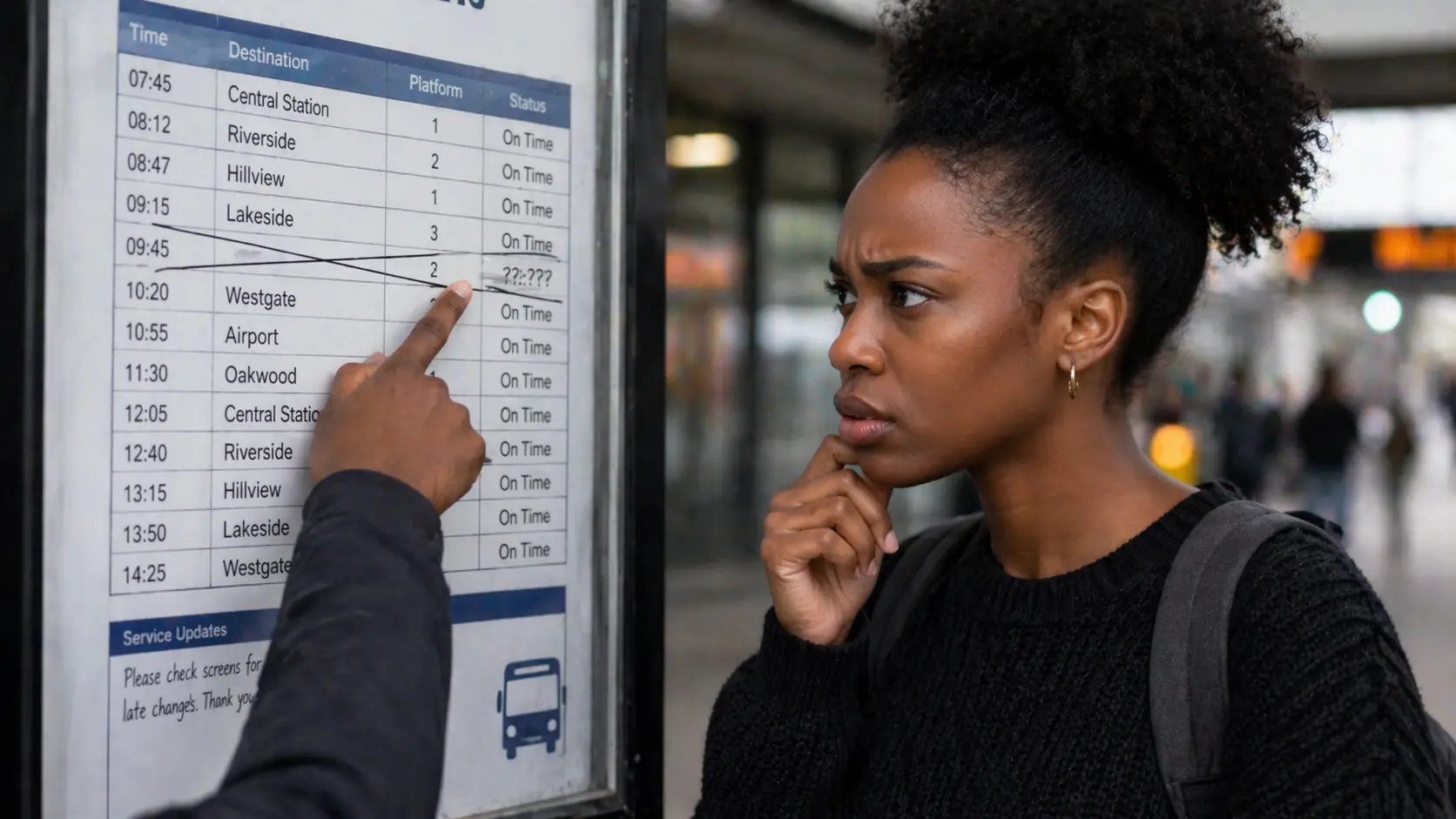
Take something that might seem unremarkable to most people: a delayed train, crowded and loud, with garbled announcements and no clear arrival time. For many autistic people, that isn’t just inconvenient. It’s a sensory spike combined with a complete loss of predictability at once. The anxiety that follows isn’t disproportionate. It’s the nervous system responding to what it has learned to interpret as a genuine threat.
Emerging evidence highlights a significant relationship between sensory processing concerns and elevated anxiety in people with autism, and research suggests that one link between sensory processing and anxiety is mediated by intolerance of uncertainty. In other words, it’s not just one thing feeding the anxiety; it’s the combination of sensory difficulty and uncertainty reinforcing each other.
Masking makes it worse
This is the piece that is hardest to explain to people who haven’t experienced it, but it’s important.
When you’re autistic, and you spend the day monitoring your tone, managing your facial expressions, calibrating how much eye contact is acceptable, scripting what to say before you say it, and suppressing the behaviours that actually help you regulate — all while navigating an environment that is already demanding more from your nervous system — the anxiety doesn’t just come from specific events. It accumulates in the background. Constantly.
Research confirms that the demands of masking are linked to chronic exhaustion and increased sensory sensitivity, and that masking and life stressors compound each other over time.
The effect is cumulative. Even in environments that seem “fine” from the outside, the internal cost of maintaining a version of yourself that fits expectations means there is rarely a point where the system is actually at rest. Anxiety in this context isn’t tied to anything specific. It’s the ongoing toll of a sustained performance with no backstage.
And when that builds long enough, it feeds directly into burnout, which in turn lowers the threshold for anxiety further. The two conditions are tightly linked, each making the other more likely.
A word on therapy, and why standard approaches frequently need to be adapted
Cognitive Behavioural Therapy (CBT) is the most commonly recommended treatment for anxiety, and it can be genuinely useful for autistic people. But — and this is an important qualification — it tends to work better when it has been adapted to fit how individuals with autism actually experience anxiety.
Standard CBT focuses on identifying and challenging distorted thought patterns. That works well when anxiety is primarily driven by cognitive distortions about things that aren’t actually dangerous. But when anxiety is driven by sensory overload, social exhaustion, and genuine environmental strain, simply reframing thoughts doesn’t get to the source. You can challenge the thought “this environment is dangerous” all you like; if the environment actually is overwhelming your nervous system, the thought isn’t distorted. It’s accurate.
Adapted approaches tend to be more effective when they include practical regulation strategies alongside thought work: building predictability, creating clear transition plans, allowing recovery time after demanding situations, and addressing sensory environments directly rather than working around them. Research suggests that interventions targeting intolerance of uncertainty specifically may be effective for people with autism, since this link is comparable in strength to what is found in non-autistic populations.
Concrete, explicit, behaviourally grounded strategies tend to land better than heavily introspective or socially abstract ones. This isn’t a reflection of intelligence or capability. It’s a reflection of how autistic people process experience, and working with that rather than against it makes a significant difference.
What actually helps
The focus with anxiety in autistic people is not, ultimately, about eliminating the feeling. It’s about reducing the conditions that keep triggering it in the first place.
Predictability and clear communication are among the most straightforward adjustments. Knowing what is happening, when, and what is expected reduces the need for constant guesswork. Something as simple as giving advance notice of a change in plans can meaningfully lower the baseline.
Sensory-friendly environments matter. Quieter spaces, adjustable lighting, and the option to wear headphones are not indulgences. They are conditions under which a nervous system already working harder than most can actually function without accumulating more strain.
Respecting routines without pathologising them is important too. When someone relies on a consistent structure to feel safe, disrupting it without warning or context does not challenge rigidity; rather, it removes a coping tool without providing anything in its place.
Recovery time is part of the picture. After social interactions, high-stimulation environments, or demanding tasks, quiet and rest aren’t avoidance. They are regulations. Without them, the load simply keeps building.
And finally, listening without immediately correcting behaviour makes a genuine difference. When withdrawal, avoidance, or shutdown are treated as signals rather than problems to be managed in the moment, it becomes far easier to understand what is actually overwhelming and to respond in ways that reduce pressure rather than intensify it.
The goal is not to make anxiety go away through willpower or reframing alone. It’s to build environments and interactions where the nervous system doesn’t have to stay on high alert just to get through an ordinary day. Because when that’s the baseline, anxiety isn’t a disorder. It’s a response. And the place to start is the conditions that produce it.