

When the world becomes too much: Understanding sensory overload in autism
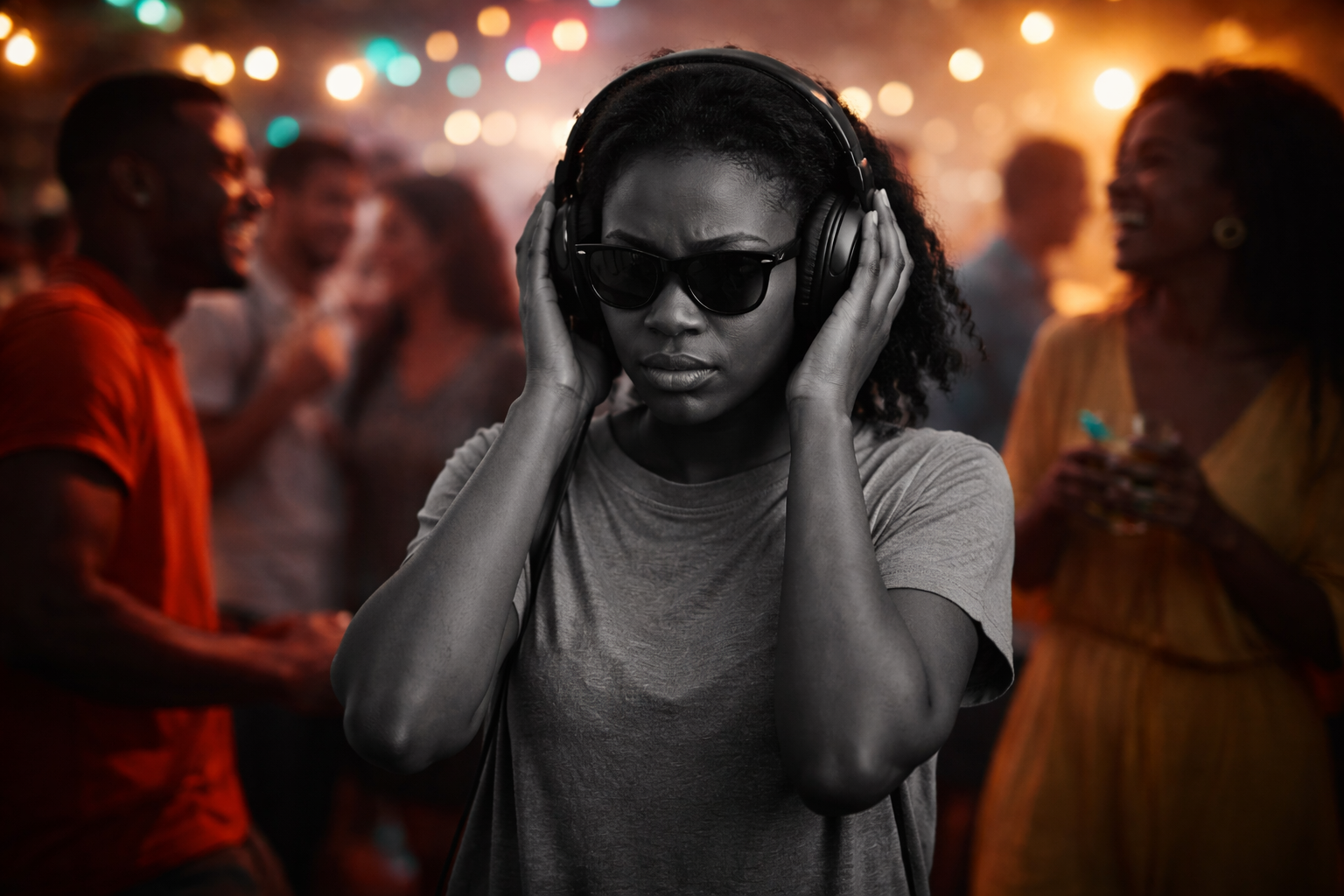
I’m at a work networking event. Nothing unusual about it: people mingling, glasses clinking, music playing softly in the background. Anyone looking at me from across the room would see someone who appears perfectly fine. But inside? It’s a completely different story.
The lights feel like they’re pressing straight into my eyes. Every sound is arriving at the same volume. Think the drag of someone’s chair, a burst of laughter, five conversations happening around me, the hum of the AC unit, and the bass in the music. Someone is speaking directly to me, and I genuinely cannot separate their voice from the voices of five other people talking behind me, basically, at a distance away. I can hear it all, but I can’t make sense of any of it.
I nod. I smile. I keep going. My chest starts to tighten. My head begins to ache. Finding the right words becomes strangely hard. The room doesn’t feel like it’s getting louder; it feels like it’s getting smaller. I shift my weight. I try to breathe steadily. I tell myself to hold on a little longer, because leaving feels like failure. Like I’m being dramatic. Like everyone else is managing just fine, and I’m the problem.
So I stay. By the time I get home, I am completely emptied. Not sleepy-tired. Depleted. The kind of exhaustion that comes not from work, but from enduring. I lie down and feel like my entire system has switched itself off.
That is sensory overload. And it happens to me more than most people realise.
So what exactly is sensory processing?
Every single second of your waking life, your brain is being flooded with information, including what you can see, hear, smell, taste, touch, and feel in your own body. Sensory processing is how your brain makes sense of all of that. It decides what deserves your attention right now and what can quietly fade into the background.
For most people, this happens automatically. The hum of the fridge disappears. Distant traffic stops registering. The feeling of your clothes stops being noticeable after a few minutes. The brain just sorts it all out without you having to think about it. Important things come to the front; irrelevant things get tucked away.
For many autistic people, that sorting system works differently.
Instead of filtering what’s relevant from what isn’t, our brains can take in more detail than others and struggle to decide which details actually matter. So nothing fades. The fridge hum stays sharp. The background conversation doesn’t blur. The texture of a collar, the fluorescent buzz above your head, the smell of someone’s perfume from across the room, it all stays equally loud and equally present, competing for attention all at once.
This isn’t a personality quirk or a sensitivity issue in the emotional sense. It is a neurological difference in how information is processed. According to the National Autistic Society, research suggests that between 53% and 95% of autistic people experience sensory processing differences in the United Kingdom. The Autism Research Institute puts it even higher: between 93% and 96% of individuals with autism experience sensory processing differences to such an extent that they significantly impact daily functioning.
That is not a niche issue. That is the majority of autistic people, quietly navigating a world that was not designed with their nervous systems in mind.
What it actually looks like
Sensory differences in autism generally show up in one of two directions, though many of us experience a mix of both, depending on the day and the situation.
- Hypersensitivity:
This means that certain sensations hit far harder than they should. A slightly bright room might feel painfully intense. A sound that barely registers for the person next to you, such as a tap dripping, someone chewing, or the buzz of a fluorescent light, might feel like it’s filling your entire head. Certain fabrics can feel unbearable on the skin. For many, sensory oversensitivity can lead to severe distress and social withdrawal and significantly impair the ability to engage in daily activities or interact socially.
- Hyposensitivity
This is the opposite of hypersensitivity. This is where certain sensory information doesn’t register as much as expected. Someone who experiences this might not notice pain, temperature, or hunger in the usual way and may seek out stronger input, including more pressure, more movement, more stimulation, just to feel grounded.
In 2013, when the fifth edition of the Diagnostic and Statistical Manual of Mental Disorders (DSM-5) was published, it was the first time sensory reactivity was formally included in the diagnostic criteria for autism, which tells you something about how long it took for the medical world to take what autistic people had been saying about their own experiences seriously.
Why people with autism reach overload
Think of sensory processing capacity like a cup. Every sensation that comes in takes up a little space in that cup. For many neurotypical people, the cup drains quickly and efficiently. For autistic people, it often drains much more slowly, and because our nervous systems don’t filter as automatically, things fill it faster too.
A few things make us particularly prone to overload:
- The brain may not automatically tune out background noise, so everything arrives at equal intensity. Some senses register more strongly than they do for others.
- Multiple sensory inputs arriving at the same time can feel fragmented rather than blend into one coherent experience.
- And crucially, small stresses add up. Sensory overload can be triggered by a single event, like an unexpected loud noise, or it can build up over time due to the effort it takes to cope with sensory sensitivities in daily life.
- That last point is the one people often miss. It’s not just the loud concert or the crowded market that tips someone over. It’s wearing a slightly scratchy top all day. And the fluorescent lighting at work. And the open-plan office noise. And the crowded commute home. Each one is manageable on its own. Together, for hours? The cup overflows.
Extra connections within a local sensory area create excess “noise” and make it difficult for the brain to filter out unimportant sensory information. This is brain structure and function, not a choice, not a weakness, not something someone can simply push through if they try hard enough.
What it feels like when it happens
From the outside, someone in sensory overload might look fine. Quiet, maybe a little withdrawn. You might not notice anything at all.
From the inside, it is urgent and physical. It can feel like panic. Like there is no space left in your mind for anything else. Words become hard to find. Thinking becomes difficult. The need to escape can feel genuinely overwhelming.
It can end in a meltdown, where emotions become too intense to contain, and the reaction looks, to anyone watching, like an extreme outburst that seems disproportionate to the situation. Or it can end in a shutdown, where the system just goes quiet. Someone stops speaking, stops responding, and withdraws completely. Children and adults who shut down can often be overlooked because their overload is less visible than those who melt down.
Neither response is a tantrum. Neither is a manipulation. Both are what happens when a nervous system reaches its limit.
It’s not only autistic people, but it is different for us
Sensory overload is not exclusive to autism. People with ADHD, anxiety, PTSD, and certain neurological conditions like migraines can all experience it. The thread that connects them is the same: the brain’s capacity to process incoming information has been exceeded.
What differs is why the threshold is lower. For autistic people, it is rooted in how the nervous system processes and integrates sensory input from the ground up. It is not situational. It does not go away when the stressful event passes. And it does not get better simply by being exposed to more of the same environment and being told to push through.
For many people with autism, sensory stimuli are not just uncomfortable but can be intensely painful, and exposure to those stimuli does not reduce pain or make it more tolerable.
Why you should care about this
If you are not autistic, you might be wondering why this matters to you. And honestly, that’s a fair question, so let me answer it directly.
The autistic person who left your event early was not being antisocial. The colleague who wears headphones at their desk is not being rude. The child who covers their ears in a restaurant is not being difficult. The adult who needs an hour alone after a party is not being dramatic.
They are managing a nervous system that is doing significantly more work than yours in the same environment. And they are often doing that work invisibly, because showing it tends to attract judgement rather than understanding.
Sensory sensitivity and avoidance are not the same as disliking something, and exposing an autistic person to known triggers can be distressing and painful. The right response is not to push someone to just cope. It is to understand what is actually happening and to ask how you can help make a space more manageable.
That starts with knowing what sensory processing is, which is exactly why this post exists.
This is Part One of a series on sensory experiences in autism. Next up: When the world gets too loud, a deeper look at the signs of sensory overload, what tends to trigger it, and why it is so often misread from the outside.